

Illustration by Paul Shinn
So I popped along to the opening of 123 Bethnal Green Road this week with Amelia, here who I found outside clutching her phone, more about medications looking a little anxious, sickness surrounded by Dr Noki’s entourage of weird and wonderful fashionos. I hadn’t expected this at all – and then remembered that this new store boasted an entire floor of Dr Noki’s fashions. Amelia and I both remarked what an exhausting effort it must be to be part of his clan, which left me wondering what said clan members wear to the supermarket – surely not this rig-out everyday?

Illustration by Paul Shinn
123 Bethnal Green Road promises to be a ‘sustainable fashion concept store’ and is many years in the making – gosh, that place has been ‘opening soon!’ longer than I’ve been in London. It’s a beautiful on both the inside and the outside, though – and a skim of the press release reveals, unsurprisingly, that it’s a listed building – which probably explains the hold up in it’s opening.

Illustration by Andrea Peterson
Brought to you from the people behind Vintage For Sale, these guys know their fashion and the store stocks a range of sustainable goods – from Dr Noki’s somewhat strange NHS range featuring the now ‘iconic’ New Era reworked hats, to vintage finds with the ’123′ label. The latter being more my cup of tea (with no offence to Dr Noki, of course) here there’s lots of interesting finds. Reclaimed fabrics have been reworked by the 123 design team, featuring the most covetable cuts – mini skirts, layered tops and ruffles are aplenty, making using of fascinating fabrics with all sorts of colours, patterns and textures.

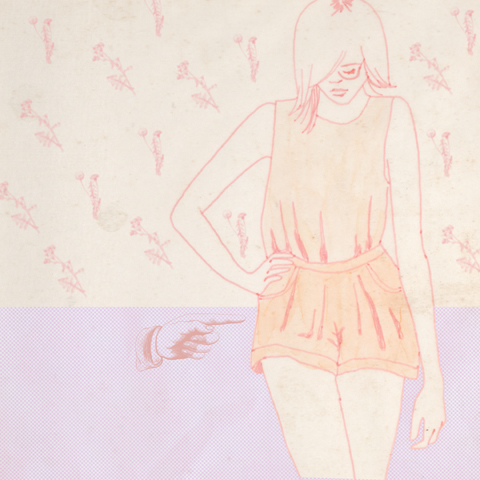
Illustrations by Natasha Thompson
The store dedicates an entire floor to whacky Dr Noki, described as a ‘fashion rebel’. The doctor (I’d like to see his accreditation, please) is famed for said New-Era re-workings and outlandish creations, including turd necklaces for pregnant women. Yeah, you heard me. His ethos is a good one, though – he’s challenging the corporate giants of the fashion industry and creating one-off art pieces that, for all their nu-rave conotations, are pretty stunning…

…and the evening will remembered for Noki and his harem of followers, who push the fashion boundaries and are aching to be photographed (which suits me fine). Here are some photographs from the event for you to feast your eyes on:


Look at this guy. ACHING to be photographed, I tell ya. Pubis tattoos will be everywhere come SS2011.


All photographs by Matt Bramford

Feelin’ hot hot hot… we arrived at the field with a blanket and straw hat, check and headed straight to the bar. Queuing for what felt like a life-time in the blistering heat, advice sounds of Johnny Flynn drifted through the air along with the smells of barbecued sausages. Queuing aside, we were happy.
Ciders in hand we weaved through camping chairs and stepped apologetically over blankets, occasionally catching the odd sandaled foot or splashing a little cider over a resting head… all part of the joy of festivalling, we found a spot, lay the blanket on the ground just in time for Laura Marling to take to the stage. ‘Afternoon everyone!’ Laura’s soothing voice echoed over the masses, ‘what a day!’…. people woo’d and clapped and cheered. In two years, Marling’s voice and lyrics have matured from pretty ditties to soulful folk… and her performance this weekend reeled in an eclectic crowd. Folk of all ages stood, eyes fixed and humming and Marling’s voice resonated. Songs from Marling’s latest album I Speak Because I Can mixed with original tracks from My Manic and I had us reminiscing, spinning around and singing-along.

Between sets we ate, drank and lay gazing into the brilliant blue ether… catching a bit of celebrity football, Mumford & Sons giving it their best. Seasick Steve was next up, and took to the stage with crowds-a-roaring. Unfortunately, due to minor sunstroke, we weren’t around for the whole set, but from what we saw, as always Seasick gave a cracking performance.
Mumford & Sons belted out there emotive country-inspired folk, now well-known from their vast radio coverage, and had the audience fixed. Looking and sounding the part, and slotting in perfectly to the Hop Farm scene.

Whilst queuing for a lamb kofta and chatting to a wonderful lady who lives on a pig farm in Cambridgeshire, who told me stories of her days as a festival queen in the 70s… (she was so small she used to crouch on the loo seat, feet on the seat – to avoid sitting on it… little ladies – take note!) Ray Davies performed and it came as pleasant surprise to hear the well-known Kinks records: Lola, You Really Got Me and all the rest. At the age of 66, Ray’s voice carried across fields, still very much in tact.
Last but not least, good old Bob Dylan appeared on stage, his (very) husky tones hooking the expectant field of fans, and taking them on a tumultuous journey through a plethora of songs steeped in sentiment.

Finally, an incredible set from Devendra Banhart ensued; no longer the long-haired folky-dolky guy that once plucked at our heartstrings, Devendra has completely reinvented his style: short-back-and-sides, checked shirt and long yellow cardie buttoned up; the sounds were funky and playful, his voice endearing and still with that jagged edge that made him famous. Even a few Roxy Music covers were thrown in to get us grooving. We danced until the cows came home.
All in all, a grand day out. Thank you Hop Farm!

Mia Farrow, visit illustrated by Natasha Thompson
Tall tales of cursed jewels are ten a penny. From the classic novel The Moonstone to the very real Hope diamond, the story is pretty formulaic: huge gem is prised from eye socket of sacred statue; setting in motion a thousand misfortunes – like an Indiana Jones-style booby trap. The curse followed the Moonstone from exotic India to the English countryside; and the hapless Marie Antoinette is falsely rumoured to have lost her head wearing the huge Hope diamond.
In fact there seems to be a sneaking suspicion that there can be hell to pay for gems with a murky past. But the modern-day mystery surrounding supermodel Naomi Campbell and the blood diamond that actress Mia Farrow alleges she received from Charles Taylor, former president of Liberia and war criminal, over at Nelson Mandela’s pad, shows not only is truth stranger than fiction, but that mud – or should that be blood? – sticks.
Since 2002 when The Kimberley Process “[an] … initiative to stem the flow of conflict diamonds – rough diamonds used by rebel movements to finance wars against legitimate governments.” was introduced, and with a little help from Leonardo DiCaprio’s 2006 box office hit, consumers have been keen to bag rocks with a clearer conscience. In fact the ethical jewellery movement has gained such momentum that this year’s London Jewellery Week (LJW) saw the launch of Essence, ‘an Ethical Jewellery Pavilion’. Showcasing pioneering ethical luxury jewellery brands like CRED and Fifi Bijoux alongside cutting edge names, like Ute Decker who uses recycled silver and bio resin, and some future glitterati from London Metropolitan University experimenting with materials like nylon.
Christian Cheesman, of CRED, speaking at the What is Ethical Jewellery? Debate at LJW said, for him, ethical jewellery means redefining luxury to encompass “inner or spiritual values”. But the union of spirit and sparkle is not an easy one. Cyanide, the favoured poison of many an Agatha Christie murderer, is used to extract gold, with lethal leakages into local water supplies a potential by product. According to the No Dirty Gold (NDG) campaign a gold ring results in 20 tonnes of mine waste. And miners, often fleeced by manipulative middle men, live lacking life’s bare necessities. Thus CRED The “world’s first Fair Trade jewellery retailer” uses Oro Verde green gold, “the most loved gold in the world”, to create its wedding rings. Oro Verde gold being produced using an “environmentally sustainable, socially responsible form of artisanal mining”.

Illustration by Jenny Costello
NDG’s slogan: ‘The more you know, the less gold glows.’ is exactly the knowledge Vivien Johnston, Director of Fifi Bijoux, is keen to harness. Recently dubbed “The Fairest of Them All” by Harpers Bazaar, Fifi Bijoux highlights hot topics with discreet designs in ethically sourced materials: from the humming bird pendant ‘inspired by our fragile earth’ to the Little Acorn pendant with 10% of profits going to sponsor children at risk of exploitation in Ghanaian mines. When I suggest to Vivien it’s about ‘educating’ the consumer she corrects me, it’s about making an “informed choice”, whether that is ethical or not, she says.
Which brings us to ‘Essence’, a curious name for a jewellery showcase? It evokes aromas and flavours, not twinkling trinkets. But according to the Oxford English Dictionary ‘essence’ can also mean:”the intrinsic nature of something; the quality which determines something’s character.”. And it’s this facet of the word which resonates with the ethical jewellery ethos. We buy jewellery to mark memorable moments in our lives; and the meaning attributed to these special pieces makes it all the more imperitive they be produced in the best possible way. Ute Decker, for example, influenced by the Japanese philosophy of wabi sabi, crudely ‘imperfect beauty’, makes a feature of the creative process itself so that “…each object carries a meaning beyond its functional use.”.
And from next Valentine’s Day wearing your heart on your sleeve – or round your lover’s neck – will be made easier with the launch of Fairtrade Fairmined gold, the first ever third party independent certification for gold, developed by Fairtrade Labelling Organisations International (FLO) and the Alliance for Responsible Mining (ARM). The launch date seems to symbolise the need to ‘spread the love’ all the way from your luxury pad here to impoverished mining communities there; as well as emphasising ethics as a high priority consideration to privileged consumers.

Naomi Campbell, illustrated by James Wilson
So as notorious Naomi hotfoots it to The Hague to testify at the U.N.-backed Special Court for Sierra Leone, to “…help clarify events in 1997.”, it seems hardly surprising that someone with a string of ethical boobs to her name – famously U-turning on her “I’d rather go naked than wear fur” campaign for PETA – may be embroiled in such a saga. However, perhaps, this time, the ever fascinating flawed star will pull in the punters the good and the green sometimes fail to reach, casting some light on an industry which often bedazzles and beguiles. Let’s just hope, this time, her heart is in the right place.
Categories ,Alliance for Responsible Mining, ,Blood Diamond, ,Charles Taylor, ,CRED, ,Diamonds, ,Essence, ,Ethical Jewellery, ,fairtrade, ,Fifi Bijoux, ,ghana, ,Hope Diamond, ,Indiana Jones, ,Jewels, ,Leonardo DiCaprio, ,Liberia, ,London Jewellery Week, ,London Metropolitan University, ,Marie Antoinette, ,Mia Farrow, ,Naomi Campbell, ,Nelson Mandela, ,No Dirty Gold, ,Oro Verde, ,Oxford English Dictionary, ,PETA, ,Sierra Leone, ,The Hague, ,The Kimberley Process, ,The Moonstone, ,Ute Decker, ,Vivien Johnston
Similar Posts:
- Fifi Bijoux: an interview with luxury ethical jewellery designer Vivien Johnston
- Competition: Ada Zanditon for Ingle and Rhode to celebrate the launch of Fairtrade Gold
- An interview with Oak fine fairtrade jewellers
- Central Saint Martins: MA Design Jewellery Graduate Show 2011 Review
- An interview with jewellery designer Katie Rowland