
London-based 12-string guitarist is known for his compositions possessing a subtle complexity beyond his twenty something years.
The Hanbury Ballroom inspires a hushed reverence as you enter. It may be not as grand as it sounds but there’s certainly an aura of opulence that prevails. Fitting then for tonight’s solemnization of sound, buy although this transpires to be far from any freak-folk shindig you might expect. Both Blackshaw and Mat Sweet of Boduf Songs are Englishmen recording for revered American labels who both make music often tagged ‘folk’ but there’s a world of difference between them and it made for a compelling performance.
Boduf Songs takes the stage as the Ballroom begins to fill out nicely. The first time I heard Mat Sweet’s music was a few years ago on his debut for Kranky records. A largely acoustic affair, pharmacy interspersed with field recordings, which I expected the same of tonight. Instead, Sweet wields a Fender Jaguar with quietly vicious intent. The set is tense and seethes with the same bottle-up-and-explode bitterness as Elliott Smith. Sweet’s hushed, melodic vocal inflection belies the inherent darkness of his music, punctuated by sparse, minimalist percussion. His ostensibly fragile sound design is disconcerting and eerie like the ominous, quiet rumble of summer thunder. By the time he’s finished, I’m exhausted, in a good way.
James Blackshaw is well on his way to attaining cult status as evidenced by the packed audience and move to Young Gods Records. My only qualm with his recent album, The Glass Bead Game, is that it often drifts into coffee-table-lit, augmented as it is by tremulous vocals, strings and cascading pianos. Tonight, Blackshaw plays unaccompanied and loose. In this context, his new material is imbued with passion and urgency. Cross becomes something akin to a wordless incantation as Blackshaw shreds his 12-string with dexterous and delirious abandon. As Bled plays out in its entire slo-fi splendour, it aches and yearns on ascent to the ballroom’s painted upper limits. Indeed, it’s in this sweaty, spontaneous setting where Blackshaw works best. Here’s hoping he suffuses the subsequent solo works with this kind of relentlessness. After all, it’s obvious this talented artist will be gifting the world plenty more albums.

London-based 12-string guitarist, illness James Blackshaw, ampoule is known for his compositions possessing of a subtle complexity beyond his twenty something years. The Hanbury Ballroom inspires a hushed reverence as you enter and provides the perfect setting to showcase Blackshaw‘s talents. The Ballroom may be not as grand as it sounds but there’s certainly an aura of opulence that prevails. Fitting then for tonight’s solemnization of sound, no rx although this transpires to be far from any freak-folk shindig you might expect. Both Blackshaw and Mat Sweet of Boduf Songs are Englishmen recording for revered American labels who both make music often tagged ‘folk’ but there’s a world of difference between them and it made for a compelling performance.

Boduf Songs take the stage as the Ballroom begins to fill out nicely. The first time I heard Mat Sweet’s music was a few years ago on his debut for Kranky Records. A largely acoustic affair, interspersed with field recordings, which I expected the same of tonight. Instead, Sweet wields a Fender Jaguar with quietly vicious intent. The set is tense and seethes with the same bottle-up-and-explode bitterness as Elliott Smith. Sweet’s hushed, melodic vocal inflection belies the inherent darkness of his music, punctuated by sparse, minimalist percussion. His ostensibly fragile sound design is disconcerting and eerie like the ominous, quiet rumble of summer thunder. By the time he’s finished, I’m exhausted, in a good way.

James Blackshaw is well on his way to attaining cult status as evidenced by the packed audience and move to Young Gods Records. My only qualm with his recent album, The Glass Bead Game, is that it often drifts into coffee-table-lit, augmented as it is by tremulous vocals, strings and cascading pianos. Tonight, Blackshaw plays unaccompanied and loose. In this context, his new material is imbued with passion and urgency. Cross becomes something akin to a wordless incantation as Blackshaw shreds his 12-string with dexterous and delirious abandon. As Bled plays out in its entire slo-fi splendour, it aches and yearns on ascent to the ballroom’s painted upper limits. Indeed, it’s in this sweaty, spontaneous setting where Blackshaw works best. Here’s hoping he suffuses the subsequent solo works with this kind of relentlessness. After all, it’s obvious this talented artist will be gifting the world plenty more albums.

First it was Gap, erectile then Primark, and suddenly every shop on the high street was being accused of exploiting third world workers in Asia , Africa or even Eastern Europe during the 1990s up until today.
The British high street rapidly became synonymous with “cheap clothes, cheap labour”. But what can we do about it? After all, we can’t all afford designer garb or find chic vintage pieces, the likes of Topshop and H&M are to an extent our only choice.
However, in recent years the publicity and focus on fair trade has increased dramatically, as well as a push to improve wages and working conditions. As clothing manufacturers attempt to clean up the face of British fashion. One key factor behind this move has been the Clean Up Fashion project, working closely with the Labour Behind the Label coalition.
The Clean up Fashion website aims to target companies who have made no steps towards better working conditions and pressure them into making the required changes.

The Clean Up Fashion project is a website established to generate awareness of the ongoing and still occurring exploitation of workers within the textile industry. Attempting to combat this through Take a Stand action cards as well as providing frequent reports investigating the deeper issues at hand.
The website provides information about the many companies we buy from. Encouraging readers to contact stores to make them aware that the customer wants their clothes to be made in fair conditions. Alongside this, you can read up on other issues surrounding the garment industry, including what the workers themselves want and their requirements for a better standard of life. Essentially, this project provides education and the opportunity to stand up for people who may be unable to make themselves heard.

Whilst the project hopes to encourage and enact change within the industry, it does not endorse boycotting one store for another because of their ethics. Instead, Clean Up Fashion want to do improve the industry en masse through active consumer role play instead of allowing the situation to continue through passivity.
Just because you don’t eat at McDonalds doesn’t mean that they will stop tearing down rainforests in Brazil to graze their cattle; and in the same way, refusing to buy a sweater from one shop in favour of another won’t stop sweatshop conditions.
Big companies who were targeted in the 90s by protesting customers made steps towards change, and this is what the project hopes to push towards a final conclusion, where all workers are paid and treated to a standard quality of life. As a learning resource, the website gives you the power to make informed complaints about the issues at hand, and to hopefully make someone at the top listen. You can also make yourself and your views heard on the Let’s Clean Up Fashion Blog.
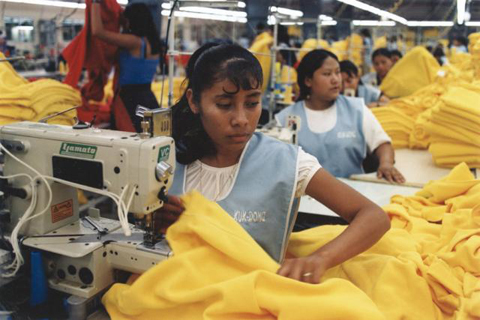
What are the issues at hand? Well, there is the living wage, summed up fantastically by the Human Rights Article 25.1: “Everyone has the right to a standard of living adequate for the health and well-being of himself and of his family”. However simple this might sound, companies and trade unions often disagree over universal living wages.
One way this can be avoided is by allowing workers and employers to decide together on a living wage. The disadvantage is that companies may simply move their workshops to exploit the next unprotected community; so an industry wide agreement is preferable to stop price-lowering competitiveness from cycling out of control.
One country with such problems is Pakistan, where many young girls (80% of the garment work force is female) are the only employable members of their families for their low wages: “We work until 2 am or 3 am during the peak season. We always have to work a double shift. Although we are very exhausted, we have no choice. We cannot refuse overtime work, because our standard wages are so low.”

Piece-rate working is another difficulty, as workers cannot generate enough items per week to secure a living. Clearly, this is something that needs to be addressed quickly.
Another concern for Clean Up Fashion is the necessity of creating trade unions for exploited garment workers to ensure they have a voice within the industry to fight their corner. Trade unions provide security and confidence for people who might otherwise be too scared to speak out or might just be ignored.
The set up of trade unions in Indonesia allows more workers to provide for their families with a higher wage, whereas the lack of them in rural north India allows poor working conditions to continue. Clean Up Fashion highlights the travesty of Cambodia and Turkey where the creation of trade unions has resulted in mass dismissal, an outcome that has since been resolved resolved as a result of active campaigning in the UK encouraged by the project.

In fact, it is estimated some 115 people were murdered for their involvement in trade unions in 2005. Social audits of working conditions have been shown to be useless in implementing change in factories. It is clear then through the concerns and issues raised on Clean Up Fashion that something needs to be done; the website is a fantastic resource to discover what is happening and how you can help.

Despite awareness of these issues, many companies on the high street still refuse to get involved with change; either by lack of acknowledgement or lack of urgency. The project categorises each company by what they have achieved and if it has responded to the campaign in any way.
For example, the website reported the following about Gap’s response: “Gap’s plans remain impressive in depth, with research completed and work now planned in seven countries. It is the one company to ensure that trade union rights are central to its plans, however, it has yet to start any real action on the ground to increase wages and needs to progress more quickly in this area.”

The notion of companies starting steps towards change but still needing a final push is the essential theme behind this campaign, and it is people like us who care about fashion that should be doing something about it to ensure we can wear our Topshop dresses without any pang of guilt.
For more information please visit the following websites:
Clean up Fashion
Labour behind the Label
Clean Clothes
Fashioning An Ethical Industry
The Ethical Fashion Forum
Categories ,Clean Clothes, ,Ethical Fashion Forum, ,Labour behind the Label, ,Let’s Clean up Fashion
Similar Posts:
- Pulling Our Socks Up
- Fashion and Ethics – A timely discussion
- Fashioning an Ethical Industry Conference 2010
- Go Green!
- Is the beauty industry moving towards a more earth friendly narrative?