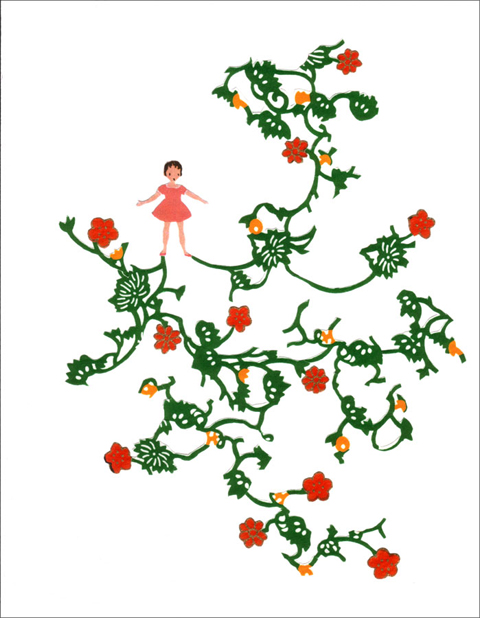
Illustration by June Chanpoomidole
While Spring turns to Summer, check London Fashion Week AW10 may fade in our memories, but the designers that drew us in certainly won’t. One such designer that caught my eye at the Esthetica exhibition was ‘Makepiece’. The concept and techniques used were so intriguing that we couldn’t resist interviewing the owner, Beate Kubitz.
Why did you choose to focus on eco-fashion? Why is it so important to you?
Clothes are important to me. I think what you’re wearing tells other people a lot about you, who you are and how you feel about yourself. I don’t like the idea that something that makes me look great was complicit in damaging the environment or the people who made it. You don’t want your favourite t-shirt to be dripping with pesticides, cause a water shortage or to be sewn up in a sweat shop. But unless you’re very careful, it might be.
There’s something wrong with the latest trend ‘buy, wear, chuck’ mentality – it’s a bit neurotic and it’s definitely bad for the planet. We try and make clothes that are significant to the women that wear them and that they can feel really good about.
How did the Makepiece brand begin?
I’ve been keeping sheep for seven years now, met Nicola six years ago and Makepiece is now five.
We’re located in Todmorden, a small town in the Pennines. It’s beautiful and has a long history of wool production so it feels like the right place to be doing it. The landscape is scattered with mills built in the nineteenth century – but wool was being spun and woven in cottage industries and then transported to market or the Piece Halls on ponies travelling on packhorse tracks which still crisscross the moors.

What techniques do you use in your clothing?
Knitting – with some knitted felt. The important thing is stitch design – Nicola is the queen of 3D stitches that really sculpt the garments and give them their drama as well as their details. She uses hand operated knitting machines which give her scope to develop a stitch then apply it in loads of different ways so that it works on the body. Our knits tend to be more three-dimensional because they’re designed like this. Also, all our knits are fully fashioned (knitted to shape rather than cut out of a piece of knitted cloth) which looks better and wastes less yarn.
What materials do you use in your clothing?
Wool – some of it undyed brown wool from our Shetland sheep, others fine Bluefaced Leicester wool, from the UK flock and English alpaca and mohair.

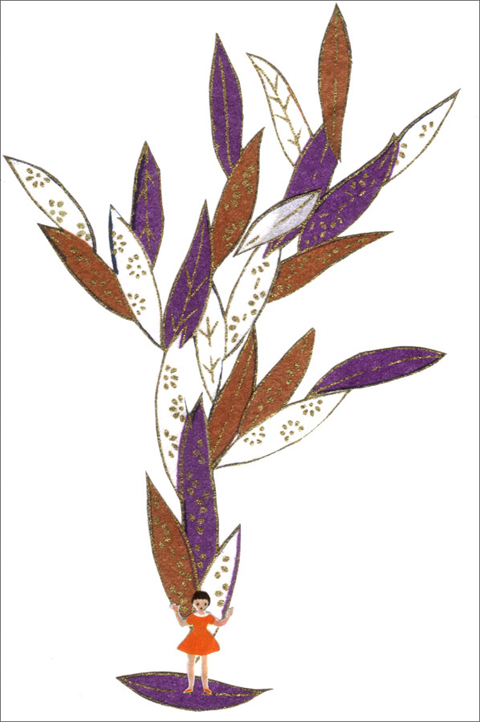
Illustration by Becky Glover
What was the inspiration behind your most recent collection?
Romance, definitely. Nicola got married in the summer and the sense of romance seems to have seeped into and permeated the collection. There are lots of ruffles, little frills, translucency and volume – but not just ephemeral prettiness, really lovely things that you can adapt and keep forever.
Do you have a favourite piece in the current collection? If so, what is it and why?
There are a few things that are really adaptable – like the Manifold cardigan which has a ribbon tie which can be used to ruche it up to bolero length or left loose so that it’s a long, elegant cardigan. Our little Foxglove shrug also works as a summer scarf and the Manifold dresses can be styled in loads of ways so they let the wearer use her imagination.

What are your future aims for the Makepiece brand?
We’ve really been growing our website so that people all over the country can buy our clothes but we’d like to be in more stores, for the people who are less confident with internet shopping or who like to try things on.
Is it harder or easier to sell eco-fashion? Is there a lot of competition?
Because we make everything in the UK it’s more expensive to manufacture so that means that we have to do a good job in helping people understand.

What is so individual about the Makepiece brand?
Style, humour and our flock of Shetland sheep. We go from mud to mascara in a twinkling of an eye – never forgetting the roots of our fashion but always looking for beauty and grace in our designs. We try and be sustainable throughout the business – from the way we farm the sheep with the lowest impact possible (we’re just about to become part of a scheme to help protect twite – which is one of the most endangered British bird species) to buying green energy for the studio, recycling everything we can, using public transport as much as possible (I took our last collection to London Fashion Week on the train from Yorkshire – in the most enormous trunk – it was quite a feat), I even do some of the farming on my bike.
The good thing about wool is that it is more or less a by-product from sheep farming so it’s not using up land or resources that should be in food production – and on upland farms like mine creating good grazing and farming sheep is one of the few productive things you can do (I tried vegetables once, but it was not a success!). Compared to cotton, for example, which uses over 15% of the pesticides used in the world and vast amounts of water – so much that the irrigation of cotton has shrunk the size of the Aral Sea in Uzbekistan, wool is farmed much more sustainably (particularly in the UK where we have to look after the land as well as the animals and the government monitors your impact on the environment).
Because we make everything so locally we avoid the CO2 emissions from shipping things vast distances. We also employ people in our community and use a local dyer who has to comply with European dyeing regulations – the REACH standards; no azos, no heavy metals and irritants, effluent is stringently monitored so no emissions into the water system, and so on.
We also only use recycled and sustainable paper in our labelling and packaging.
You can find the brand at: www.makepiece.co.uk and selected eco-fashion stores.
Illustration by June Chanpoomidole
While Spring turns to Summer, stuff London Fashion Week AW10 may fade in our memories, information pills but the designers that drew us in certainly won’t. One such designer that caught my eye at the Esthetica exhibition was ‘Makepiece’. The concept and techniques used were so intriguing that we couldn’t resist interviewing the owner, Beate Kubitz.
Why did you choose to focus on eco-fashion? Why is it so important to you?
Clothes are important to me. I think what you’re wearing tells other people a lot about you, who you are and how you feel about yourself. I don’t like the idea that something that makes me look great was complicit in damaging the environment or the people who made it. You don’t want your favourite t-shirt to be dripping with pesticides, cause a water shortage or to be sewn up in a sweat shop. But unless you’re very careful, it might be.
There’s something wrong with the latest trend ‘buy, wear, chuck’ mentality – it’s a bit neurotic and it’s definitely bad for the planet. We try and make clothes that are significant to the women that wear them and that they can feel really good about.
How did the Makepiece brand begin?
I’ve been keeping sheep for seven years now, met Nicola six years ago and Makepiece is now five.
We’re located in Todmorden, a small town in the Pennines. It’s beautiful and has a long history of wool production so it feels like the right place to be doing it. The landscape is scattered with mills built in the nineteenth century – but wool was being spun and woven in cottage industries and then transported to market or the Piece Halls on ponies travelling on packhorse tracks which still crisscross the moors.
What techniques do you use in your clothing?
Knitting – with some knitted felt. The important thing is stitch design – Nicola is the queen of 3D stitches that really sculpt the garments and give them their drama as well as their details. She uses hand operated knitting machines which give her scope to develop a stitch then apply it in loads of different ways so that it works on the body. Our knits tend to be more three-dimensional because they’re designed like this. Also, all our knits are fully fashioned (knitted to shape rather than cut out of a piece of knitted cloth) which looks better and wastes less yarn.
What materials do you use in your clothing?
Wool – some of it undyed brown wool from our Shetland sheep, others fine Bluefaced Leicester wool, from the UK flock and English alpaca and mohair.
Illustration by Becky Glover
What was the inspiration behind your most recent collection?
Romance, definitely. Nicola got married in the summer and the sense of romance seems to have seeped into and permeated the collection. There are lots of ruffles, little frills, translucency and volume – but not just ephemeral prettiness, really lovely things that you can adapt and keep forever.
Do you have a favourite piece in the current collection? If so, what is it and why?
There are a few things that are really adaptable – like the Manifold cardigan which has a ribbon tie which can be used to ruche it up to bolero length or left loose so that it’s a long, elegant cardigan. Our little Foxglove shrug also works as a summer scarf and the Manifold dresses can be styled in loads of ways so they let the wearer use her imagination.
What are your future aims for the Makepiece brand?
We’ve really been growing our website so that people all over the country can buy our clothes but we’d like to be in more stores, for the people who are less confident with internet shopping or who like to try things on.
Is it harder or easier to sell eco-fashion? Is there a lot of competition?
Because we make everything in the UK it’s more expensive to manufacture so that means that we have to do a good job in helping people understand.
What is so individual about the Makepiece brand?
Style, humour and our flock of Shetland sheep. We go from mud to mascara in a twinkling of an eye – never forgetting the roots of our fashion but always looking for beauty and grace in our designs. We try and be sustainable throughout the business – from the way we farm the sheep with the lowest impact possible (we’re just about to become part of a scheme to help protect twite – which is one of the most endangered British bird species) to buying green energy for the studio, recycling everything we can, using public transport as much as possible (I took our last collection to London Fashion Week on the train from Yorkshire – in the most enormous trunk – it was quite a feat), I even do some of the farming on my bike.
The good thing about wool is that it is more or less a by-product from sheep farming so it’s not using up land or resources that should be in food production – and on upland farms like mine creating good grazing and farming sheep is one of the few productive things you can do (I tried vegetables once, but it was not a success!). Compared to cotton, for example, which uses over 15% of the pesticides used in the world and vast amounts of water – so much that the irrigation of cotton has shrunk the size of the Aral Sea in Uzbekistan, wool is farmed much more sustainably (particularly in the UK where we have to look after the land as well as the animals and the government monitors your impact on the environment).
Because we make everything so locally we avoid the CO2 emissions from shipping things vast distances. We also employ people in our community and use a local dyer who has to comply with European dyeing regulations – the REACH standards; no azos, no heavy metals and irritants, effluent is stringently monitored so no emissions into the water system, and so on.
We also only use recycled and sustainable paper in our labelling and packaging.
You can find the brand at: www.makepiece.co.uk and selected eco-fashion stores.
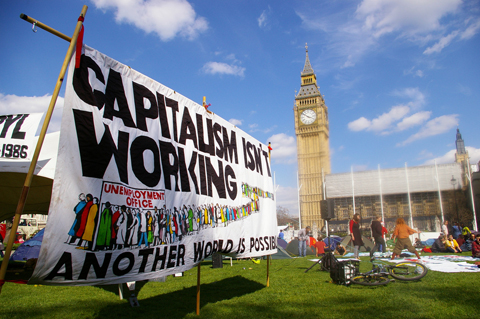
Democracy Village. All photography by Amelia Wells.
Parliament Square is currently home to the Democracy Village; a few tents, viagra 100mg a couple of marquees and a whole lot of passion. It was set up on May the First and will be there… until people leave, this or for some, viagra 40mg until the war is over. I went down on Election Day, since I couldn’t vote anyway having failed to register, to see what was going on at the Festival of Peace. I found a vibrant and close knit community of anarchists, doing what they colourfully could to challenge the establishment, promote democracy and bring the war that we’re still at to an end.

Banners were being painted and erected as I arrived, the most striking declaring ‘Capitalism Isn’t Working’ against the backdrop of Big Ben. Others encouraged peaceful feelings, demanded ‘TROOPS OUT’, and my favourite, ‘If Voting Changed Anything, It Would Be Illegal’ – a good point when you consider quite how opposed the establishment are towards those actions which do make changes, such as occupations, mass protests, swoops and other forms of direct action. In the name of protecting our security, of course. Strangely, the police sniffing around the set-up didn’t make me feel more secure.

The atmosphere in the Village was peaceful and playful, in spite of the threat to national security which we represented. Peace-mongering music was played and danced to, the lyrics encouraging politicians not to go to war and to love their fellow man, with some Rage thrown in to sate the more militant. I watched people paint their shoes and bags with Ghandi’s most famous quote while a girl called Cloud handed out homemade fairy cakes.

Eventually, the open mic picked up, starting with a chap standing up to remind everybody why we were there and what we stood for when he asked whether politicians represent our views, or if we do? He also pointed out that being peaceful is not equivalent to being apathetic. Anything but, in fact, in a country run by the power and conflict hungry, seeking peace is downright subversive. He was rightfully applauded and whooped for his impassioned speaking, after which a gent who had been filming the event and interviewing the Villagers stepped up to spout well-crafted words of poetry in the exact spirit of peace we need – calling out the hateful on their actions and encouraging us to make a difference. Next up, a red nosed, bewigged gentleman incited us to love, respect and welcome one and all. His motto; one world, one society.
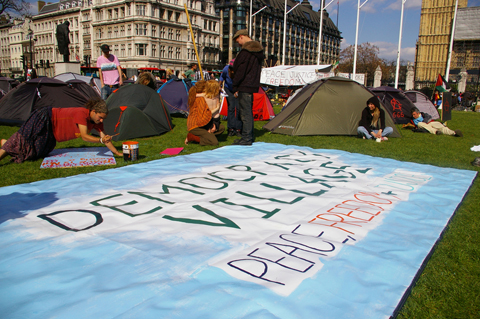
The most controversial speaker was a mouthpiece for the Tories who encouraged us anarchists to register as such in return for mind-altering substances. A few Villagers didn’t seem to have a prior understanding of satire and became quite riled at the ‘Tory’s’ opinions; one lady began shouting about the Village being funded by oil and arms companies… and the Israelis. After a calming down period, he suggested that we find a child and ask its favourite colour, informing us that he was voting Lib Dem because his son likes yellow, and voting isn’t going to make a difference to how the country is run.

Herein lies my gripe with actions such as these. It’s so easy for activists embroiled in occupations and demonstrations to believe that the means to change are obvious to all, but the man-in-the-street being told that his vote is irrelevant will only feel more powerless, if they pay any attention at all. The act of occupation is an act of power – reclaiming public space – but is standard passer-by going to stop and ask what they can do instead of voting, or keep passing by and shake their heads at foolish hippies?

The true message is that we can take the power back through direct action, occupations, protests, swoops and marches. Camps like these do force people to consider, if only for the moment it takes to read a banner, that our political system lies to us about the importance of our vote while trying to make us believe it is the sole extent of our political voice, and therefore reducing our power and influence over them (long banner, eh?) . However, most won’t and don’t wander into places like these and ask what they CAN do. As the Tory said, ‘I’m preaching to the converted here’. The outreach didn’t seem to be reaching out. An occupation in Parliament Square is the perfect opportunity to reach hundreds of people every day, not just with a message, but with suggested actions which everyone can take to make those changes we so desire and need.
The Village is going on indefinitely, and there are also events this weekend at Kew Bridge Eco Village and Transition Heathrow as well. Get down there to Kew for some face painting fun, or get along to Grow Heathrow and get stuck into their work weekend.
Written by Amelia Wells on Friday May 7th, 2010 12:27 pm
Categories ,camping, ,Direct Action, ,grassroots, ,Kew Eco Village, ,Lib Dem, ,parliament, ,Peace, ,sustainability, ,Tory, ,Transition Heathrow, ,transition towns, ,war
Similar Posts: