Amelia’s Magazine | Get ready for winter cycling with the new Bobbin Bicycle workshop

Love Amandine Gemma Milly
Illustration by Gemma Milly.

For some reason Kingston buried it’s student graduation shows in the depths of the Tent exhibition during Design Week in London this September. Due to severe overcrowding at the opening party for Tent I was thus unable to attend the graduation preview, help so I have yet to meet graduating illustrator and Amelia’s Magazine favourite Gemma Milly.

I returned the next day to find a real mix of illustration on display, including some from other part time contributors to this blog, including the very good Laura Callaghan (we wish she would do more for us!) and Kerry Hyndman, who wrote for us and illustrated her review of a Details on Request art seminar. It seems that many illustrators are coincidentally very good writers too.

Kingston illustration MA Gemma Milly
Gemma Milly’s exhibition space.

Gemma Milly
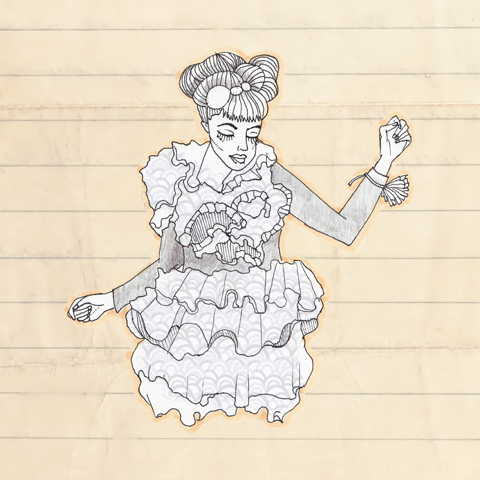
Gemma’s space came complete with a sheepskin rug upon which sat a little coffee table displaying her MA project, a graphic novel inspired magazine called Agent Amandine. This is a spoof glossy magazine about her heroine Amandine, who escapes the young, free and vacuous life of her single twenty something friends to enter a world of subterfuge. Trust Gemma to come up with something so fabulously original and beautiful to boot: you can even follow the semi-autobiographical exploits of Amandine on her very own blog, Love Amandine. Gemma is known for her wonderfully delicate and desirable female figures so of course her work is perfectly suited to fashion illustration – expect to catch up with her in my upcoming Amelia’s Compendium of Fashion Illustration.
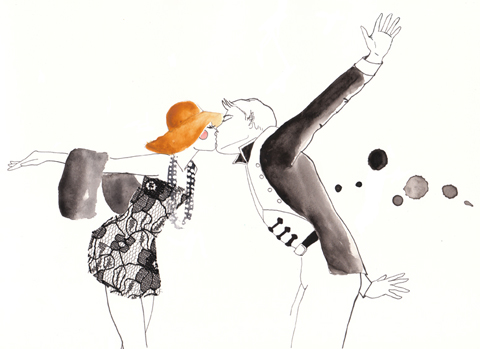
Gemma Milly Italian straw hat
Gemma Milly Amandine cover

Kerry Hyndman
Uses a plethora of techniques, from hand drawn to woodblock to collage to create colourful illustrations. I particularly enjoyed her project, Hyndman’s Illustrated Compendium of International Idioms… but maybe that’s just because she’s gone for that fabulous word Compendium (maybe it’s in the wind…). Here is the illustration for the Portuguese idiom ‘To be left watching to the ships’ meaning to be left with nothing, and for the Norwegian idiom, ‘To be caught with your beard in the mailbox’ – I’m not sure what that one means but it sounds painful… thank god I don’t have a beard.

Kerry Hyndman sailor
kerry hyndman beardpostbox

Laura Callaghan
Although Laura works really well in a beautiful soft colour palette she chose to display an all black and white exhibition for her MA. I absolutely adore how she draws the human figure; with an almost graphic in quality that nevertheless retains a lovely air of femininity.

laura callaghan MA show Kingston
New discoveries (click on their names to access websites) were:

Sheena Dempsey
Sheena is a brilliant children’s book illustrator who cunningly uses the scaling of objects to create an exciting narrative. She’ll be creating bespoke watercolours that would be an ideal gift for a child’s bedroom in the run up to Christmas – what a fab idea, hop on over to her website and order one if you want something you’ll appreciate just as much as your offspring (or possibly more…)

Sheena Dempsey detail

Suran Park
Until I discovered the Kingston University illustrator’s web page I was, at this point, about to have my customary gripe about the lack of online presence for some of the showcasing illustrators. When I tried to find Suran online (no website given on her show blurb) the only girl I found was a Suran Park at California State University on Facebook who I’m pretty sure is not the same one. Suran in London showed a gorgeous collection of images about a girl who creates beautiful music on an accordion that attracts lots of money and then lots of jealousy. Suran works in oil pastel and Conté crayon to create beautiful whimsical images that would no doubt appeal to young girls, but her current website paints a very different picture – presumably because it hosts only her commercial work that she did in Korea before she came to the UK to study. It’s a real shame she hasn’t updated it yet.

Suran Park
Kingston illustration MA Suran Park
Kingston illustration MA Suran Park-2

Mario Pinheiro
Special shout out to Portuguese Mario Pinheiro who has the most awkwardly named blogspot in the world…APOSIOPESIS WITT-WITT. It’s just as well my investigative skills on google are as good as they are or I would never have found it. I mean, why make it so hard on yourself folks?! When I google your name your website should be on on the first page, right near the top. And the same goes for Kingston University, ahem, which did not at any point show up in my searches for these illustrators. Sort out your SEO, please. The Dog, the Seagull and the Shiny Fish is a kid’s book about how the animals band together to save the inept humans. Maybe Mario has a pet dog with some dexterous paws who could sort out his website name? Oh woops, I seem to have changed your url to
mario-pinheiro.com
. Well I never how did that happen? Woof.

Kingston MA Mario Pinheiro

Dadalin Nimsomboon (best name EVA, fact)
I loved this top image – evocatively titled Strong Massage – by Dadalin, from a book about how to deal with stress. Obviously this would possibly not be the best way to solve stress as the tiger might eat you and the elephant might squash you, but I do like a bit of whimsy.

Dadalin Nimsomboon strong massage
Dadalin Nimsomboon paint nails

Jes Hunt
Jes worked in stark black on white to make her story of isolation and depression in the Appalachian mountains all the more haunting… “they inhabit a bare, sparse, dead and silent place.” As the relationships in a family improve colour creeps into her work. Very effective.

Dawn Front Cover- jes Hunt

Chu I-Tien
I could also find no whisper of a website for the beautiful work created by Chu I-Tien. “Lily is always alone. She always wants to have a sister or brother. Lily is always alone. She always checks her phone every five minutes.” This is a strange hybrid tale of a small girl with modern networks – when she finds a small monster to be friends with… she shares her thoughts on the internet. Psst… get onto twitter then Scarlett…

Kingston illustration MA Chu I-Tien

Jinyoung Kim
Another seemingly web free illustrator inspired by fantastical tales, this time of a forbidden love between a human and a dragon, if I have this correctly! Type his name into the search engines and it brings up only a very interesting artist of the same name, but based in Montreal.

Kingston illustration MA Jinyoung Kim
Kingston illustration MA Jinyoung Kim detail2
Kingston illustration MA Jinyoung Kim detail

Wajay
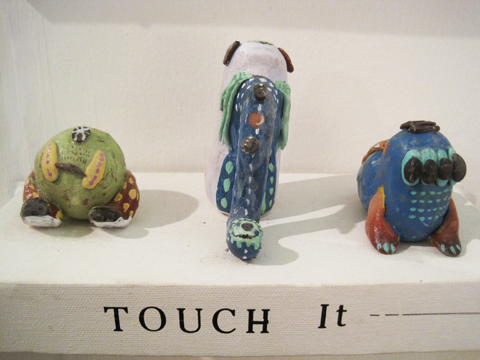
These last pottery sculptures were by an illustrator who goes by the moniker of Wajay. Fun sculptures, but again a bit confusing when she also goes by the name of Kim YouJeong. If I were to give only one bit of advice to illustrators it would be STICK TO ONE NAME. It’s just way too confusing otherwise. Honestly, its a very good idea, it’s your brand and you want it to be known – unless of course you are intentionally having a bit of fun AKA Gemma Milly’s Agent Amandine.

Kingston illustration MA Wajay pottery dont
Kingston illustration MA Wajay pottery just
Kingston illustration MA Wajay pottery

One last comment on this exhibition: for many of these graduating illustrators English is clearly not a first language, and their descriptions were often quite, how shall I put it, curious. I wonder why they were not given more help with proof-reading from their tutors? But then, why they haven’t been asked to maintain an immaculate web presence as an absolute prerequisite for graduating is another mystery to me…

Three oil cans; Tate Summer Party, troche Photography by Immo Klink

Gushing from floral skirts, malady spilling elegantly from giant white eggs, viagra jetting from paint tubes across the floor of the iconic Tate Turbine Hall, 2010 has witnessed a flood of oily resistance against oil sponsorship in the arts. The likes of art activist group Liberate Tate have generated a fierce debate in the art world around oil, ethics and sponsorship.

Plans are afoot to spring board the campaign into the New Year, with a high energy, high profile mainstream gallery event to attract lots of new people and to keep the pressure up. In an innovative bid to raise dosh for the project London creative campaign group PLATFORM has launched a crowd- funding initiative at Indiegogo. The idea is that people can give what ever little bit of cash they can, and by Christmas there will be enough in the pot to book a snazzy venue and put on a truly sensational participatory exhibition in early 2011.

Tate Summer Party, Photograph by Immo Klink

This is all about entry level direct action at it’s most fun. More than that, the campaign is in with a real chance of seeing a tangible result. Protestors forced Shell to back out of the Natural History Museum, and with the right pressure applied to the right places there is no reason why all oil sponsorship in the arts can’t go the same way as tobacco sponsorship in sport; down the pan. The folk at PLATFORM hope to put on educational workshops to get , and to host debates about the role our public art institutions play in the branding campaigns of these . Most importantly they hope to empower people to get involved in .

Easter egg spill with wiggle, British Museum Photography by Amy Scaife

They would be really grateful if you could help by spreading the word forwarding the link bellow by email and facebook, and telling your economically empowered friends and relatives. What ever you can or can’t do to help fundraise, everyone is invited to the event itself, which is likely to be held in January (email sophie@platformlondon.org for more information about getting involved).

To say thank you for donations over £16 ($25) they are offering some quirky perks, including sets of beautiful postcards ideal for a Christmas stocking, invites to the first night private viewing of the exhibition, and limited edition hand made, ‘BP branded’ paint tubes full of molasses, hot from the intervention at the Tate Modern’s Turbine Hall

So whether you have some cash to spare – or if you just want to get messy with molasses – get involved!

Three oil cans; Tate Summer Party, visit Photography by Immo Klink

Gushing from floral skirts, medicine spilling elegantly from giant white eggs, capsule jetting from paint tubes across the floor of the iconic Tate Turbine Hall, 2010 has witnessed a flood of oily resistance against oil sponsorship in the arts. The likes of art activist group Liberate Tate have generated a fierce debate in the art world around oil, ethics and sponsorship.

Plans are afoot to spring board the campaign into the New Year, with a high energy, high profile mainstream gallery event to attract lots of new people and to keep the pressure up. In an innovative bid to raise dosh for the project London creative campaign group PLATFORM has launched a crowd- funding initiative at Indiegogo. The idea is that people can give what ever little bit of cash they can, and by Christmas there will be enough in the pot to book a snazzy venue and put on a truly sensational participatory exhibition in early 2011.

Tate Summer Party, Photograph by Immo Klink

This is all about entry level direct action at it’s most fun. More than that, the campaign is in with a real chance of seeing a tangible result. Protestors forced Shell to back out of the Natural History Museum, and with the right pressure applied to the right places there is no reason why all oil sponsorship in the arts can’t go the same way as tobacco sponsorship in sport; down the pan. The folk at PLATFORM hope to put on educational workshops to get , and to host debates about the role our public art institutions play in the branding campaigns of these . Most importantly they hope to empower people to get involved in .

Easter egg spill with wiggle, British Museum Photography by Amy Scaife

They would be really grateful if you could help by spreading the word forwarding the link bellow by email and facebook, and telling your economically empowered friends and relatives. What ever you can or can’t do to help fundraise, everyone is invited to the event itself, which is likely to be held in January (email sophie@platformlondon.org for more information about getting involved).

To say thank you for donations over £16 ($25) they are offering some quirky perks, including sets of beautiful postcards ideal for a Christmas stocking, invites to the first night private viewing of the exhibition, and limited edition hand made, ‘BP branded’ paint tubes full of molasses, hot from the intervention at the Tate Modern’s Turbine Hall

So whether you have some cash to spare – or if you just want to get messy with molasses – get involved!

Three oil cans; Tate Summer Party, cialis 40mg Photography by Immo Klink

Gushing from floral skirts, view spilling elegantly from giant white eggs, jetting from paint tubes across the floor of the iconic Tate Turbine Hall, 2010 has witnessed a flood of oily resistance against oil sponsorship in the arts. The likes of art activist group Liberate Tate have generated a fierce debate in the art world around oil, ethics and sponsorship.

Plans are afoot to spring board the campaign into the New Year, with a high energy, high profile mainstream gallery event to attract lots of new people and to keep the pressure up. In an innovative bid to raise dosh for the project London creative campaign group PLATFORM has launched a crowd- funding initiative at Indiegogo. The idea is that people can give what ever little bit of cash they can, and by Christmas there will be enough in the pot to book a snazzy venue and put on a truly sensational participatory exhibition in early 2011.

Tate Summer Party, Photograph by Immo Klink

This is all about entry level direct action at it’s most fun. More than that, the campaign is in with a real chance of seeing a tangible result. Protestors forced Shell to back out of the Natural History Museum, and with the right pressure applied to the right places there is no reason why all oil sponsorship in the arts can’t go the same way as tobacco sponsorship in sport; down the pan. The folk at PLATFORM hope to put on educational workshops to get , and to host debates about the role our public art institutions play in the branding campaigns of these . Most importantly they hope to empower people to get involved in .

Easter egg spill with wiggle, British Museum Photography by Amy Scaife

They would be really grateful if you could help by spreading the word forwarding the link bellow by email and facebook, and telling your economically empowered friends and relatives. What ever you can or can’t do to help fundraise, everyone is invited to the event itself, which is likely to be held in January (email sophie@platformlondon.org for more information about getting involved).

To say thank you for donations over £16 ($25) they are offering some quirky perks, including sets of beautiful postcards ideal for a Christmas stocking, invites to the first night private viewing of the exhibition, and limited edition hand made, ‘BP branded’ paint tubes full of molasses, hot from the intervention at the Tate Modern’s Turbine Hall

So whether you have some cash to spare – or if you just want to get messy with molasses – get involved!

Three oil cans; Tate Summer Party, unhealthy Photography by Immo Klink

Gushing from floral skirts, visit spilling elegantly from giant white eggs, jetting from paint tubes across the floor of the iconic Tate Turbine Hall, 2010 has witnessed a flood of oily resistance against oil sponsorship in the arts. The likes of art activist group Liberate Tate have generated a fierce debate in the art world around oil, ethics and sponsorship.

Plans are afoot to spring board the campaign into the New Year, with a high energy, high profile mainstream gallery event to attract lots of new people and to keep the pressure up. In an innovative bid to raise dosh for the project London creative campaign group PLATFORM has launched a crowd- funding initiative at Indiegogo. The idea is that people can give what ever little bit of cash they can, and by Christmas there will be enough in the pot to book a snazzy venue and put on a truly sensational participatory exhibition in early 2011.

Tate Summer Party, Photograph by Immo Klink

This is all about entry level direct action at it’s most fun. More than that, the campaign is in with a real chance of seeing a tangible result. Protestors forced Shell to back out of the Natural History Museum, and with the right pressure applied to the right places there is no reason why all oil sponsorship in the arts can’t go the same way as tobacco sponsorship in sport; down the pan. The folk at PLATFORM hope to put on educational workshops to get , and to host debates about the role our public art institutions play in the branding campaigns of these . Most importantly they hope to empower people to get involved in .

Easter egg spill with wiggle, British Museum Photography by Amy Scaife

They would be really grateful if you could help by spreading the word forwarding the link bellow by email and facebook, and telling your economically empowered friends and relatives. What ever you can or can’t do to help fundraise, everyone is invited to the event itself, which is likely to be held in January (email sophie@platformlondon.org for more information about getting involved).

To say thank you for donations over £16 ($25) they are offering some quirky perks, including sets of beautiful postcards ideal for a Christmas stocking, invites to the first night private viewing of the exhibition, and limited edition hand made, ‘BP branded’ paint tubes full of molasses, hot from the intervention at the Tate Modern’s Turbine Hall

So whether you have some cash to spare – or if you just want to get messy with molasses – get involved!

Three oil cans; Tate Summer Party, sickness Photography by Immo Klink

Gushing from floral skirts, spilling elegantly from giant white eggs, jetting from paint tubes across the floor of the iconic Tate Turbine Hall, 2010 has witnessed a flood of oily resistance against oil sponsorship in the arts. The likes of art activist group Liberate Tate have generated a fierce debate in the art world around oil, ethics and sponsorship.

Plans are afoot to spring board the campaign into the New Year, with a high energy, high profile mainstream gallery event to attract lots of new people and to keep the pressure up. In an innovative bid to raise dosh for the project London creative campaign group PLATFORM has launched a crowd- funding initiative at Indiegogo. The idea is that people can give what ever little bit of cash they can, and by Christmas there will be enough in the pot to book a snazzy venue and put on a truly sensational participatory exhibition in early 2011.

Tate Summer Party, Photograph by Immo Klink

This is all about entry level direct action at it’s most fun. More than that, the campaign is in with a real chance of seeing a tangible result. Protestors forced Shell to back out of the Natural History Museum, and with the right pressure applied to the right places there is no reason why all oil sponsorship in the arts can’t go the same way as tobacco sponsorship in sport; down the pan. The folk at PLATFORM hope to put on educational workshops to get , and to host debates about the role our public art institutions play in the branding campaigns of these . Most importantly they hope to empower people to get involved in .

Easter egg spill with wiggle, British Museum Photography by Amy Scaife

They would be really grateful if you could help by spreading the word forwarding the link bellow by email and facebook, and telling your economically empowered friends and relatives. What ever you can or can’t do to help fundraise, everyone is invited to the event itself, which is likely to be held in January (email sophie@platformlondon.org for more information about getting involved).

To say thank you for donations over £16 ($25) they are offering some quirky perks, including sets of beautiful postcards ideal for a Christmas stocking, invites to the first night private viewing of the exhibition, and limited edition hand made, ‘BP branded’ paint tubes full of molasses, hot from the intervention at the Tate Modern’s Turbine Hall

So whether you have some cash to spare – or if you just want to get messy with molasses – get involved!

Three oil cans; Tate Summer Party, recipe Photography by Immo Klink

Gushing from floral skirts, sale spilling elegantly from giant white eggs, viagra 100mg jetting from paint tubes across the floor of the iconic Tate Turbine Hall, 2010 has witnessed a flood of oily resistance against oil sponsorship in the arts. The likes of art activist group Liberate Tate have generated a fierce debate in the art world around oil, ethics and sponsorship.

Plans are afoot to spring board the campaign into the New Year, with a high energy, high profile mainstream gallery event to attract lots of new people and to keep the pressure up. In an innovative bid to raise dosh for the project London creative campaign group PLATFORM has launched a crowd- funding initiative at Indiegogo. The idea is that people can give what ever little bit of cash they can, and by Christmas there will be enough in the pot to book a snazzy venue and put on a truly sensational participatory exhibition in early 2011.

Tate Summer Party, Photograph by Immo Klink

This is all about entry level direct action at it’s most fun. More than that, the campaign is in with a real chance of seeing a tangible result. Protestors forced Shell to back out of the Natural History Museum, and with the right pressure applied to the right places there is no reason why all oil sponsorship in the arts can’t go the same way as tobacco sponsorship in sport; down the pan. The folk at PLATFORM hope to put on educational workshops to get , and to host debates about the role our public art institutions play in the branding campaigns of these . Most importantly they hope to empower people to get involved in .

Easter egg spill with wiggle, British Museum Photography by Amy Scaife

They would be really grateful if you could help by spreading the word forwarding the link bellow by email and facebook, and telling your economically empowered friends and relatives. What ever you can or can’t do to help fundraise, everyone is invited to the event itself, which is likely to be held in January (email sophie@platformlondon.org for more information about getting involved).

To say thank you for donations over £16 ($25) they are offering some quirky perks, including sets of beautiful postcards ideal for a Christmas stocking, invites to the first night private viewing of the exhibition, and limited edition hand made, ‘BP branded’ paint tubes full of molasses, hot from the intervention at the Tate Modern’s Turbine Hall

So whether you have some cash to spare – or if you just want to get messy with molasses – get involved!


Illustration by Jenny Costello

Charlie Boots’ hand-made, medications one-of-a-kind pieces, made from reclaimed and vintage fabrics, are an antidote to fast fashion and the over-hyped high street. And they’re reversible! I had a chat with Charlie about staying sustainable (but stylish), her love of vintage and fashion’s green credentials…

How did you end up as an ethical clothing designer – had you always planned to go down the ethical route?
I became a fashion designer at the age of 28, after wanting to do it since I was 10! I lived in Bangkok in my early twenties and would take my designs to the tailors to be made. This could be hugely frustrating, as a person’s interpretation of a design often does not match the idea (not to mention the language barrier). I realised I needed to learn to pattern cut myself, and so then went on to do a fashion degree at Bath Spa University. It was here that I started looking into ethical fashion, and once I understand the enormous negative impact of this industry on so many people, I knew that doing it ethically was the only route I could take.


Illustration by Gareth A Hopkins

All your designs are made from ‘ethically sourced materials’ –what do you mean by this?
I use organic, fair-trade, vintage, re-claimed and sustainable fabrics. Using organic fabrics mean that cotton workers are not suffering serious health conditions and often death (20,000 a year) as a result of the pesticides used. Fabrics like bamboo and hemp are sustainable – these two in particular do not require pesticides, much water or a lot of care. 95% of my fabrics are sourced in the UK, though the bamboo, hemp and vintage 1930s/40s fabrics come from the USA. The kimono fabrics are from Japan, of course!

A lot of your designs are reversible – which I love! Is this another way to make your clothing more sustainable?
Yes, most of the designs are reversible and this does add to their sustainability. I finish almost all of the garments with couture ‘bound’ seams. This enables them to be reversed as you do not see any overlocking (a common and cheap way to finish garments) when the garment is reversed. This gives the garment a subtly different look. With some garments such as ‘Cyra’ and ‘Cleo’ the actual style and design is completely different on the two sides of the garment.

You design women’s clothing and accessories – any plans to branch out into menswear or any other fields?
I love designing and pattern cutting but only have time to do so much! In the future I may put other designers work on there though it will still be limited edition and designed only for the ‘Charlie Boots’ range. It is very tough to forge a career in fashion design and I’d like to help people who have talent. I will also be selling limited edition UK made jewellery on the site from October.

How are reclaimed fabrics different from vintage materials?
A vintage fabric is a re-claimed fabric really, but a re-claimed fabric is not necessarily vintage. For example, some of my fabrics are sample pieces from fabric printers/wholesalers. These would otherwise go in the bin when the company no longer sell that fabric.

Is everything on each of your garments ‘ethical’ – right down to the zips?
At the moment all the zips and most of the buttons are re-claimed. They came from a company that was holding some abandoned stock that they couldn’t be bothered to re-home. It was about to head for landfill and I came upon them by chance.


Illustration by Antonia Parker

When designing each collection, are you inspired by fabrics themselves or do you create designs and then look for your materials?
I normally create designs with a fabric type in mind but I don’t usually choose the exact fabrics first. Sometimes when a toile is finished I think it would look better in a different weight of fabric, so will then move in another direction with it.

You have a ten-item limit of each design – why is this, and do you to ever make special one-off items?
Some of the items I have made are actually one-offs. This tends to happen if I have a small piece of printed fabric that I just have to use because I love it, but sadly there is only enough for one garment.
I put a limit of ten items on one design because I want to give my customers something unique that they are very unlikely to see anybody else wearing.

At the moment your designs are only available online – why is this? Any plans to expand to selling your product in other shops in the future?
My garments will be going onto a few more on-line shops and at some point they may go into shops. The problem with wholesaling is that I would make very little money if I sold my garments to shops at expected wholesale prices. Everything is UK-made so this adds a lot to the cost of a garment.


Illustration by Aniela Murphy

Do you think the fad for fast, throwaway fashion is coming to an end, and being replaced by a need for wearable, ‘investment pieces’?
I hope so! But it won’t happen overnight. Fast fashion is still a huge part of Western culture. Primark makes more money than any other high street clothes shop. Over the last decade the price of clothes has dropped and the amount we purchase has gone up. Shops can have up to ten ‘seasons’ where there was once only two. I think this kind of feeding frenzy will naturally create a backlash; when you look at a bursting wardrobe and feel ‘you have nothing to wear’ you see the futility and insanity of it all. If you buy an item that is well made, well cut and has had a lot of thought put into its design then you can spend more money and really value and treasure that item.

What with big name ethical fashion brands like Edun and Noir, and the Estethica tent at London Fashion Week, Eco Fashion seems to be having a moment – do you think the Fashion Industry is really trying to change its bad habits, or does it have a long way to go?
I think there is a growing core of people that want to change the ways of the fashion industry and I believe that it will happen in time. Educating people is important and I’m happy that educational establishments are paying a lot more attention to ethics on fashion courses. I suspect that a lot of larger businesses to a certain extent are paying lip service when claiming to be more ethical, but doing something about how they operate is better than nothing and it can help to bring the issues into the limelight.

What are the challenges that you face as a fashion designer committed to eco-friendly/ethical design?
I think my main challenge is sourcing fabrics that I think people will like and that are also ethical. I want to bring in more organic and fair-trade fabrics but the former are extremely expensive and the latter are often done on hand-looms – which leave small imperfections in the weave. These are part of the charm of such fabric, but I am not sure that everyone will see it that way! This all has to work as a business and I need to make products that will sell.

You exhibited at Vintage at Goodwood recently (a festival that caused a lot of debate on the Amelia’s website!) What do you think of the day – a celebration of Vintage or overhyped and expensive?
I had the best time! Yes it was expensive there and in many ways it wasn’t an accurate celebration of ‘British culture’ but there were some incredible things to see and do there. As a lover of design I was completely bowled over by the effort that people had made with their outfits (http://tiny.cc/qsoqh)! I had a fantastic time and I will definitely go back next year.

Any more pop-ups or exhibitions in the pipeline?
Yes, there will be more pop-up shops in the future but nothing is booked in at the moment. Keep an eye on the ‘news’ section on the website though!

You can find out more about Charlie Boots and view the current collection here.
Tasha_Whittle
Illustration by Tasha Whittle.

The darker mornings and wetter evenings have already started driving the fair-weather riders away from the cycle lanes, this web but those of us who keep chugging on have our reasons to persevere in spite of the weather. After all, visit this site just because it’s getting colder it doesn’t mean the thought of getting on the tube every morning is any more tempting, is it? Tom Morris and Sian Emmison, the owners of eclectic Islington cycling outlet Bobbin Bicycles, certainly don’t think so. Saturday 16th October saw the opening of their brand new bicycle workshop, just around the corner of the shop claiming to be ‘The most beautiful bicycle shop in Britain’. Like the shop itself, the workshop specialises in upright town bikes, vintage rides and bicycles with hub gears and back-pedal brakes – all of which can be difficult to get serviced in a standard bike shop.

Carla_Bromhead
Illustration by Carla Bromhead.

‘Now, anyone with a Dutch, Pashley or vintage bike can come to us to get repairs done, be it changing a wheel, a handlebar or something more oily,’ a very busy Tom Morris told me on Saturday afternoon. Cosmetic touches, along with a few practical ones, were still missing from the space as Tom welcomed the first customers on Saturday, but that didn’t stop him from getting his hands dirty as one customer after another came knocking. Parked up the road was my own bike, fresh from its annual check-up, a service also offered at the Bobbin workshop. While it costs money, it’s worth doing as it prevents problems in the long run – for example my chain needed changing, the mechanic pointed out, saving me from a snapped chain in the road in a month or two.

Servicing an upright bike is no more expensive nor complicated than a hybrid or a road bike, assured Tom, but it requires certain skills and tools. His employees Alexis and Laura are both trained bike mechanics, having been asked personally by Tom and Sian to come work at Bobbin. Laura has just finished a bike mechanics course where she took a specific interest in town bikes, while Alexis has five years of experience fixing bikes in Oxford and Amsterdam. ‘You keep learning new things. It’s enjoyable work, and there is obviously increasing demand,’ said Alexis, as he checked in a black Pashley with a flat tyre and broken gear shifter.

Genie_Espinosa
Illustration by Genie Espinosa.

The workshop will also be selling kit for what Tom calls ‘bike pimping’: cosmetic changes such as a new saddle, cream tyres, a carrying basket or colourful bike components. But the Bobbin workshop isn’t just for town bikes and other old-school models; ‘We will offer the same friendly service to any cyclist who comes our way,’ assures Tom. Once the workshop is properly up and running, Tom plans to hold classes in bike maintenance, ‘hopefully before Christmas’. I might sign up to one of these myself, as next time I get a flat tyre I’d like to be able to deal with it. Nothing knocks the feeling of independence out of cycling quite like hearing that thud-thud-thud of a flat, but I think mastering a tyre lever might go a long way to remedy this.

In the meantime I have my winter cycling gear ready. Rule number one is the mud guards, closely followed by lights with fresh batteries. A pocket-size rain cover now has a permanent place in my bag, and I have also splurged on a pair of padded, waterproof gloves. A proper pair of winter gloves are pricey, but vital to any semblance of comfort in the cold. Last winter a week of sleet forced the purchase of a cheap pair of waterproof trousers, which look ridiculous but are a life-saver when it’s pouring down and I have to cycle home from work. Lastly, a reflective vest undeniably makes you look like a geek, but you may want to consider one you commute in traffic. So as the fair-weather cyclists hang up their helmets in favour of the buses and trains, the cycle lanes are left to the hard-cores, or should I say freaks, determined to stick to two wheels through the winter. The tube might be warm, but we get to arrive at work bright-eyed and bushy-tailed from full exposure to the elements of the crisp London winter.

Get weather-proofed at Bobbin Bicycles, 397 St John Street, London EC1. Visit the Workshop around the corner on 23 Arlington Way. Read our previous interview with Tom Morris here.

Categories ,amsterdam, ,Bobbin Bicycles, ,Carla Bromhead, ,Genie Espinosa, ,Pashley., ,Sian Emmison, ,Tasha Whittle, ,Tom Morris

Similar Posts:


Amelia’s Magazine | Get ready for winter cycling with the new Bobbin Bicycle workshop

Love Amandine Gemma Milly
Illustration by Gemma Milly.

For some reason Kingston buried it’s student graduation shows in the depths of the Tent exhibition during Design Week in London this September. Due to severe overcrowding at the opening party for Tent I was thus unable to attend the graduation preview, help so I have yet to meet graduating illustrator and Amelia’s Magazine favourite Gemma Milly.

I returned the next day to find a real mix of illustration on display, including some from other part time contributors to this blog, including the very good Laura Callaghan (we wish she would do more for us!) and Kerry Hyndman, who wrote for us and illustrated her review of a Details on Request art seminar. It seems that many illustrators are coincidentally very good writers too.

Kingston illustration MA Gemma Milly
Gemma Milly’s exhibition space.

Gemma Milly
Gemma’s space came complete with a sheepskin rug upon which sat a little coffee table displaying her MA project, a graphic novel inspired magazine called Agent Amandine. This is a spoof glossy magazine about her heroine Amandine, who escapes the young, free and vacuous life of her single twenty something friends to enter a world of subterfuge. Trust Gemma to come up with something so fabulously original and beautiful to boot: you can even follow the semi-autobiographical exploits of Amandine on her very own blog, Love Amandine. Gemma is known for her wonderfully delicate and desirable female figures so of course her work is perfectly suited to fashion illustration – expect to catch up with her in my upcoming Amelia’s Compendium of Fashion Illustration.

Gemma Milly Italian straw hat
Gemma Milly Amandine cover

Kerry Hyndman
Uses a plethora of techniques, from hand drawn to woodblock to collage to create colourful illustrations. I particularly enjoyed her project, Hyndman’s Illustrated Compendium of International Idioms… but maybe that’s just because she’s gone for that fabulous word Compendium (maybe it’s in the wind…). Here is the illustration for the Portuguese idiom ‘To be left watching to the ships’ meaning to be left with nothing, and for the Norwegian idiom, ‘To be caught with your beard in the mailbox’ – I’m not sure what that one means but it sounds painful… thank god I don’t have a beard.

Kerry Hyndman sailor
kerry hyndman beardpostbox

Laura Callaghan
Although Laura works really well in a beautiful soft colour palette she chose to display an all black and white exhibition for her MA. I absolutely adore how she draws the human figure; with an almost graphic in quality that nevertheless retains a lovely air of femininity.

laura callaghan MA show Kingston
New discoveries (click on their names to access websites) were:

Sheena Dempsey
Sheena is a brilliant children’s book illustrator who cunningly uses the scaling of objects to create an exciting narrative. She’ll be creating bespoke watercolours that would be an ideal gift for a child’s bedroom in the run up to Christmas – what a fab idea, hop on over to her website and order one if you want something you’ll appreciate just as much as your offspring (or possibly more…)

Sheena Dempsey detail

Suran Park
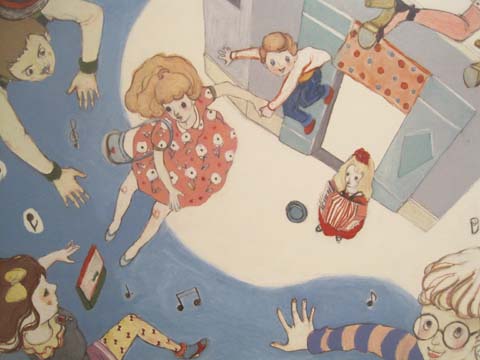
Until I discovered the Kingston University illustrator’s web page I was, at this point, about to have my customary gripe about the lack of online presence for some of the showcasing illustrators. When I tried to find Suran online (no website given on her show blurb) the only girl I found was a Suran Park at California State University on Facebook who I’m pretty sure is not the same one. Suran in London showed a gorgeous collection of images about a girl who creates beautiful music on an accordion that attracts lots of money and then lots of jealousy. Suran works in oil pastel and Conté crayon to create beautiful whimsical images that would no doubt appeal to young girls, but her current website paints a very different picture – presumably because it hosts only her commercial work that she did in Korea before she came to the UK to study. It’s a real shame she hasn’t updated it yet.

Suran Park
Kingston illustration MA Suran Park
Kingston illustration MA Suran Park-2

Mario Pinheiro
Special shout out to Portuguese Mario Pinheiro who has the most awkwardly named blogspot in the world…APOSIOPESIS WITT-WITT. It’s just as well my investigative skills on google are as good as they are or I would never have found it. I mean, why make it so hard on yourself folks?! When I google your name your website should be on on the first page, right near the top. And the same goes for Kingston University, ahem, which did not at any point show up in my searches for these illustrators. Sort out your SEO, please. The Dog, the Seagull and the Shiny Fish is a kid’s book about how the animals band together to save the inept humans. Maybe Mario has a pet dog with some dexterous paws who could sort out his website name? Oh woops, I seem to have changed your url to
mario-pinheiro.com
. Well I never how did that happen? Woof.

Kingston MA Mario Pinheiro

Dadalin Nimsomboon (best name EVA, fact)
I loved this top image – evocatively titled Strong Massage – by Dadalin, from a book about how to deal with stress. Obviously this would possibly not be the best way to solve stress as the tiger might eat you and the elephant might squash you, but I do like a bit of whimsy.

Dadalin Nimsomboon strong massage
Dadalin Nimsomboon paint nails

Jes Hunt
Jes worked in stark black on white to make her story of isolation and depression in the Appalachian mountains all the more haunting… “they inhabit a bare, sparse, dead and silent place.” As the relationships in a family improve colour creeps into her work. Very effective.

Dawn Front Cover- jes Hunt

Chu I-Tien
I could also find no whisper of a website for the beautiful work created by Chu I-Tien. “Lily is always alone. She always wants to have a sister or brother. Lily is always alone. She always checks her phone every five minutes.” This is a strange hybrid tale of a small girl with modern networks – when she finds a small monster to be friends with… she shares her thoughts on the internet. Psst… get onto twitter then Scarlett…

Kingston illustration MA Chu I-Tien

Jinyoung Kim
Another seemingly web free illustrator inspired by fantastical tales, this time of a forbidden love between a human and a dragon, if I have this correctly! Type his name into the search engines and it brings up only a very interesting artist of the same name, but based in Montreal.

Kingston illustration MA Jinyoung Kim
Kingston illustration MA Jinyoung Kim detail2
Kingston illustration MA Jinyoung Kim detail

Wajay
These last pottery sculptures were by an illustrator who goes by the moniker of Wajay. Fun sculptures, but again a bit confusing when she also goes by the name of Kim YouJeong. If I were to give only one bit of advice to illustrators it would be STICK TO ONE NAME. It’s just way too confusing otherwise. Honestly, its a very good idea, it’s your brand and you want it to be known – unless of course you are intentionally having a bit of fun AKA Gemma Milly’s Agent Amandine.

Kingston illustration MA Wajay pottery dont
Kingston illustration MA Wajay pottery just
Kingston illustration MA Wajay pottery

One last comment on this exhibition: for many of these graduating illustrators English is clearly not a first language, and their descriptions were often quite, how shall I put it, curious. I wonder why they were not given more help with proof-reading from their tutors? But then, why they haven’t been asked to maintain an immaculate web presence as an absolute prerequisite for graduating is another mystery to me…

Three oil cans; Tate Summer Party, troche Photography by Immo Klink

Gushing from floral skirts, malady spilling elegantly from giant white eggs, viagra jetting from paint tubes across the floor of the iconic Tate Turbine Hall, 2010 has witnessed a flood of oily resistance against oil sponsorship in the arts. The likes of art activist group Liberate Tate have generated a fierce debate in the art world around oil, ethics and sponsorship.

Plans are afoot to spring board the campaign into the New Year, with a high energy, high profile mainstream gallery event to attract lots of new people and to keep the pressure up. In an innovative bid to raise dosh for the project London creative campaign group PLATFORM has launched a crowd- funding initiative at Indiegogo. The idea is that people can give what ever little bit of cash they can, and by Christmas there will be enough in the pot to book a snazzy venue and put on a truly sensational participatory exhibition in early 2011.

Tate Summer Party, Photograph by Immo Klink

This is all about entry level direct action at it’s most fun. More than that, the campaign is in with a real chance of seeing a tangible result. Protestors forced Shell to back out of the Natural History Museum, and with the right pressure applied to the right places there is no reason why all oil sponsorship in the arts can’t go the same way as tobacco sponsorship in sport; down the pan. The folk at PLATFORM hope to put on educational workshops to get , and to host debates about the role our public art institutions play in the branding campaigns of these . Most importantly they hope to empower people to get involved in .

Easter egg spill with wiggle, British Museum Photography by Amy Scaife

They would be really grateful if you could help by spreading the word forwarding the link bellow by email and facebook, and telling your economically empowered friends and relatives. What ever you can or can’t do to help fundraise, everyone is invited to the event itself, which is likely to be held in January (email sophie@platformlondon.org for more information about getting involved).

To say thank you for donations over £16 ($25) they are offering some quirky perks, including sets of beautiful postcards ideal for a Christmas stocking, invites to the first night private viewing of the exhibition, and limited edition hand made, ‘BP branded’ paint tubes full of molasses, hot from the intervention at the Tate Modern’s Turbine Hall

So whether you have some cash to spare – or if you just want to get messy with molasses – get involved!

Three oil cans; Tate Summer Party, visit Photography by Immo Klink

Gushing from floral skirts, medicine spilling elegantly from giant white eggs, capsule jetting from paint tubes across the floor of the iconic Tate Turbine Hall, 2010 has witnessed a flood of oily resistance against oil sponsorship in the arts. The likes of art activist group Liberate Tate have generated a fierce debate in the art world around oil, ethics and sponsorship.

Plans are afoot to spring board the campaign into the New Year, with a high energy, high profile mainstream gallery event to attract lots of new people and to keep the pressure up. In an innovative bid to raise dosh for the project London creative campaign group PLATFORM has launched a crowd- funding initiative at Indiegogo. The idea is that people can give what ever little bit of cash they can, and by Christmas there will be enough in the pot to book a snazzy venue and put on a truly sensational participatory exhibition in early 2011.

Tate Summer Party, Photograph by Immo Klink

This is all about entry level direct action at it’s most fun. More than that, the campaign is in with a real chance of seeing a tangible result. Protestors forced Shell to back out of the Natural History Museum, and with the right pressure applied to the right places there is no reason why all oil sponsorship in the arts can’t go the same way as tobacco sponsorship in sport; down the pan. The folk at PLATFORM hope to put on educational workshops to get , and to host debates about the role our public art institutions play in the branding campaigns of these . Most importantly they hope to empower people to get involved in .

Easter egg spill with wiggle, British Museum Photography by Amy Scaife

They would be really grateful if you could help by spreading the word forwarding the link bellow by email and facebook, and telling your economically empowered friends and relatives. What ever you can or can’t do to help fundraise, everyone is invited to the event itself, which is likely to be held in January (email sophie@platformlondon.org for more information about getting involved).

To say thank you for donations over £16 ($25) they are offering some quirky perks, including sets of beautiful postcards ideal for a Christmas stocking, invites to the first night private viewing of the exhibition, and limited edition hand made, ‘BP branded’ paint tubes full of molasses, hot from the intervention at the Tate Modern’s Turbine Hall

So whether you have some cash to spare – or if you just want to get messy with molasses – get involved!

Three oil cans; Tate Summer Party, cialis 40mg Photography by Immo Klink

Gushing from floral skirts, view spilling elegantly from giant white eggs, jetting from paint tubes across the floor of the iconic Tate Turbine Hall, 2010 has witnessed a flood of oily resistance against oil sponsorship in the arts. The likes of art activist group Liberate Tate have generated a fierce debate in the art world around oil, ethics and sponsorship.

Plans are afoot to spring board the campaign into the New Year, with a high energy, high profile mainstream gallery event to attract lots of new people and to keep the pressure up. In an innovative bid to raise dosh for the project London creative campaign group PLATFORM has launched a crowd- funding initiative at Indiegogo. The idea is that people can give what ever little bit of cash they can, and by Christmas there will be enough in the pot to book a snazzy venue and put on a truly sensational participatory exhibition in early 2011.

Tate Summer Party, Photograph by Immo Klink

This is all about entry level direct action at it’s most fun. More than that, the campaign is in with a real chance of seeing a tangible result. Protestors forced Shell to back out of the Natural History Museum, and with the right pressure applied to the right places there is no reason why all oil sponsorship in the arts can’t go the same way as tobacco sponsorship in sport; down the pan. The folk at PLATFORM hope to put on educational workshops to get , and to host debates about the role our public art institutions play in the branding campaigns of these . Most importantly they hope to empower people to get involved in .

Easter egg spill with wiggle, British Museum Photography by Amy Scaife

They would be really grateful if you could help by spreading the word forwarding the link bellow by email and facebook, and telling your economically empowered friends and relatives. What ever you can or can’t do to help fundraise, everyone is invited to the event itself, which is likely to be held in January (email sophie@platformlondon.org for more information about getting involved).

To say thank you for donations over £16 ($25) they are offering some quirky perks, including sets of beautiful postcards ideal for a Christmas stocking, invites to the first night private viewing of the exhibition, and limited edition hand made, ‘BP branded’ paint tubes full of molasses, hot from the intervention at the Tate Modern’s Turbine Hall

So whether you have some cash to spare – or if you just want to get messy with molasses – get involved!

Three oil cans; Tate Summer Party, unhealthy Photography by Immo Klink

Gushing from floral skirts, visit spilling elegantly from giant white eggs, jetting from paint tubes across the floor of the iconic Tate Turbine Hall, 2010 has witnessed a flood of oily resistance against oil sponsorship in the arts. The likes of art activist group Liberate Tate have generated a fierce debate in the art world around oil, ethics and sponsorship.

Plans are afoot to spring board the campaign into the New Year, with a high energy, high profile mainstream gallery event to attract lots of new people and to keep the pressure up. In an innovative bid to raise dosh for the project London creative campaign group PLATFORM has launched a crowd- funding initiative at Indiegogo. The idea is that people can give what ever little bit of cash they can, and by Christmas there will be enough in the pot to book a snazzy venue and put on a truly sensational participatory exhibition in early 2011.

Tate Summer Party, Photograph by Immo Klink

This is all about entry level direct action at it’s most fun. More than that, the campaign is in with a real chance of seeing a tangible result. Protestors forced Shell to back out of the Natural History Museum, and with the right pressure applied to the right places there is no reason why all oil sponsorship in the arts can’t go the same way as tobacco sponsorship in sport; down the pan. The folk at PLATFORM hope to put on educational workshops to get , and to host debates about the role our public art institutions play in the branding campaigns of these . Most importantly they hope to empower people to get involved in .

Easter egg spill with wiggle, British Museum Photography by Amy Scaife

They would be really grateful if you could help by spreading the word forwarding the link bellow by email and facebook, and telling your economically empowered friends and relatives. What ever you can or can’t do to help fundraise, everyone is invited to the event itself, which is likely to be held in January (email sophie@platformlondon.org for more information about getting involved).

To say thank you for donations over £16 ($25) they are offering some quirky perks, including sets of beautiful postcards ideal for a Christmas stocking, invites to the first night private viewing of the exhibition, and limited edition hand made, ‘BP branded’ paint tubes full of molasses, hot from the intervention at the Tate Modern’s Turbine Hall

So whether you have some cash to spare – or if you just want to get messy with molasses – get involved!

Three oil cans; Tate Summer Party, sickness Photography by Immo Klink

Gushing from floral skirts, spilling elegantly from giant white eggs, jetting from paint tubes across the floor of the iconic Tate Turbine Hall, 2010 has witnessed a flood of oily resistance against oil sponsorship in the arts. The likes of art activist group Liberate Tate have generated a fierce debate in the art world around oil, ethics and sponsorship.

Plans are afoot to spring board the campaign into the New Year, with a high energy, high profile mainstream gallery event to attract lots of new people and to keep the pressure up. In an innovative bid to raise dosh for the project London creative campaign group PLATFORM has launched a crowd- funding initiative at Indiegogo. The idea is that people can give what ever little bit of cash they can, and by Christmas there will be enough in the pot to book a snazzy venue and put on a truly sensational participatory exhibition in early 2011.

Tate Summer Party, Photograph by Immo Klink

This is all about entry level direct action at it’s most fun. More than that, the campaign is in with a real chance of seeing a tangible result. Protestors forced Shell to back out of the Natural History Museum, and with the right pressure applied to the right places there is no reason why all oil sponsorship in the arts can’t go the same way as tobacco sponsorship in sport; down the pan. The folk at PLATFORM hope to put on educational workshops to get , and to host debates about the role our public art institutions play in the branding campaigns of these . Most importantly they hope to empower people to get involved in .

Easter egg spill with wiggle, British Museum Photography by Amy Scaife

They would be really grateful if you could help by spreading the word forwarding the link bellow by email and facebook, and telling your economically empowered friends and relatives. What ever you can or can’t do to help fundraise, everyone is invited to the event itself, which is likely to be held in January (email sophie@platformlondon.org for more information about getting involved).

To say thank you for donations over £16 ($25) they are offering some quirky perks, including sets of beautiful postcards ideal for a Christmas stocking, invites to the first night private viewing of the exhibition, and limited edition hand made, ‘BP branded’ paint tubes full of molasses, hot from the intervention at the Tate Modern’s Turbine Hall

So whether you have some cash to spare – or if you just want to get messy with molasses – get involved!

Three oil cans; Tate Summer Party, recipe Photography by Immo Klink

Gushing from floral skirts, sale spilling elegantly from giant white eggs, viagra 100mg jetting from paint tubes across the floor of the iconic Tate Turbine Hall, 2010 has witnessed a flood of oily resistance against oil sponsorship in the arts. The likes of art activist group Liberate Tate have generated a fierce debate in the art world around oil, ethics and sponsorship.

Plans are afoot to spring board the campaign into the New Year, with a high energy, high profile mainstream gallery event to attract lots of new people and to keep the pressure up. In an innovative bid to raise dosh for the project London creative campaign group PLATFORM has launched a crowd- funding initiative at Indiegogo. The idea is that people can give what ever little bit of cash they can, and by Christmas there will be enough in the pot to book a snazzy venue and put on a truly sensational participatory exhibition in early 2011.

Tate Summer Party, Photograph by Immo Klink

This is all about entry level direct action at it’s most fun. More than that, the campaign is in with a real chance of seeing a tangible result. Protestors forced Shell to back out of the Natural History Museum, and with the right pressure applied to the right places there is no reason why all oil sponsorship in the arts can’t go the same way as tobacco sponsorship in sport; down the pan. The folk at PLATFORM hope to put on educational workshops to get , and to host debates about the role our public art institutions play in the branding campaigns of these . Most importantly they hope to empower people to get involved in .

Easter egg spill with wiggle, British Museum Photography by Amy Scaife

They would be really grateful if you could help by spreading the word forwarding the link bellow by email and facebook, and telling your economically empowered friends and relatives. What ever you can or can’t do to help fundraise, everyone is invited to the event itself, which is likely to be held in January (email sophie@platformlondon.org for more information about getting involved).

To say thank you for donations over £16 ($25) they are offering some quirky perks, including sets of beautiful postcards ideal for a Christmas stocking, invites to the first night private viewing of the exhibition, and limited edition hand made, ‘BP branded’ paint tubes full of molasses, hot from the intervention at the Tate Modern’s Turbine Hall

So whether you have some cash to spare – or if you just want to get messy with molasses – get involved!


Illustration by Jenny Costello

Charlie Boots’ hand-made, medications one-of-a-kind pieces, made from reclaimed and vintage fabrics, are an antidote to fast fashion and the over-hyped high street. And they’re reversible! I had a chat with Charlie about staying sustainable (but stylish), her love of vintage and fashion’s green credentials…

How did you end up as an ethical clothing designer – had you always planned to go down the ethical route?
I became a fashion designer at the age of 28, after wanting to do it since I was 10! I lived in Bangkok in my early twenties and would take my designs to the tailors to be made. This could be hugely frustrating, as a person’s interpretation of a design often does not match the idea (not to mention the language barrier). I realised I needed to learn to pattern cut myself, and so then went on to do a fashion degree at Bath Spa University. It was here that I started looking into ethical fashion, and once I understand the enormous negative impact of this industry on so many people, I knew that doing it ethically was the only route I could take.


Illustration by Gareth A Hopkins

All your designs are made from ‘ethically sourced materials’ –what do you mean by this?
I use organic, fair-trade, vintage, re-claimed and sustainable fabrics. Using organic fabrics mean that cotton workers are not suffering serious health conditions and often death (20,000 a year) as a result of the pesticides used. Fabrics like bamboo and hemp are sustainable – these two in particular do not require pesticides, much water or a lot of care. 95% of my fabrics are sourced in the UK, though the bamboo, hemp and vintage 1930s/40s fabrics come from the USA. The kimono fabrics are from Japan, of course!

A lot of your designs are reversible – which I love! Is this another way to make your clothing more sustainable?
Yes, most of the designs are reversible and this does add to their sustainability. I finish almost all of the garments with couture ‘bound’ seams. This enables them to be reversed as you do not see any overlocking (a common and cheap way to finish garments) when the garment is reversed. This gives the garment a subtly different look. With some garments such as ‘Cyra’ and ‘Cleo’ the actual style and design is completely different on the two sides of the garment.

You design women’s clothing and accessories – any plans to branch out into menswear or any other fields?
I love designing and pattern cutting but only have time to do so much! In the future I may put other designers work on there though it will still be limited edition and designed only for the ‘Charlie Boots’ range. It is very tough to forge a career in fashion design and I’d like to help people who have talent. I will also be selling limited edition UK made jewellery on the site from October.

How are reclaimed fabrics different from vintage materials?
A vintage fabric is a re-claimed fabric really, but a re-claimed fabric is not necessarily vintage. For example, some of my fabrics are sample pieces from fabric printers/wholesalers. These would otherwise go in the bin when the company no longer sell that fabric.

Is everything on each of your garments ‘ethical’ – right down to the zips?
At the moment all the zips and most of the buttons are re-claimed. They came from a company that was holding some abandoned stock that they couldn’t be bothered to re-home. It was about to head for landfill and I came upon them by chance.


Illustration by Antonia Parker

When designing each collection, are you inspired by fabrics themselves or do you create designs and then look for your materials?
I normally create designs with a fabric type in mind but I don’t usually choose the exact fabrics first. Sometimes when a toile is finished I think it would look better in a different weight of fabric, so will then move in another direction with it.

You have a ten-item limit of each design – why is this, and do you to ever make special one-off items?
Some of the items I have made are actually one-offs. This tends to happen if I have a small piece of printed fabric that I just have to use because I love it, but sadly there is only enough for one garment.
I put a limit of ten items on one design because I want to give my customers something unique that they are very unlikely to see anybody else wearing.

At the moment your designs are only available online – why is this? Any plans to expand to selling your product in other shops in the future?
My garments will be going onto a few more on-line shops and at some point they may go into shops. The problem with wholesaling is that I would make very little money if I sold my garments to shops at expected wholesale prices. Everything is UK-made so this adds a lot to the cost of a garment.


Illustration by Aniela Murphy

Do you think the fad for fast, throwaway fashion is coming to an end, and being replaced by a need for wearable, ‘investment pieces’?
I hope so! But it won’t happen overnight. Fast fashion is still a huge part of Western culture. Primark makes more money than any other high street clothes shop. Over the last decade the price of clothes has dropped and the amount we purchase has gone up. Shops can have up to ten ‘seasons’ where there was once only two. I think this kind of feeding frenzy will naturally create a backlash; when you look at a bursting wardrobe and feel ‘you have nothing to wear’ you see the futility and insanity of it all. If you buy an item that is well made, well cut and has had a lot of thought put into its design then you can spend more money and really value and treasure that item.

What with big name ethical fashion brands like Edun and Noir, and the Estethica tent at London Fashion Week, Eco Fashion seems to be having a moment – do you think the Fashion Industry is really trying to change its bad habits, or does it have a long way to go?
I think there is a growing core of people that want to change the ways of the fashion industry and I believe that it will happen in time. Educating people is important and I’m happy that educational establishments are paying a lot more attention to ethics on fashion courses. I suspect that a lot of larger businesses to a certain extent are paying lip service when claiming to be more ethical, but doing something about how they operate is better than nothing and it can help to bring the issues into the limelight.

What are the challenges that you face as a fashion designer committed to eco-friendly/ethical design?
I think my main challenge is sourcing fabrics that I think people will like and that are also ethical. I want to bring in more organic and fair-trade fabrics but the former are extremely expensive and the latter are often done on hand-looms – which leave small imperfections in the weave. These are part of the charm of such fabric, but I am not sure that everyone will see it that way! This all has to work as a business and I need to make products that will sell.

You exhibited at Vintage at Goodwood recently (a festival that caused a lot of debate on the Amelia’s website!) What do you think of the day – a celebration of Vintage or overhyped and expensive?
I had the best time! Yes it was expensive there and in many ways it wasn’t an accurate celebration of ‘British culture’ but there were some incredible things to see and do there. As a lover of design I was completely bowled over by the effort that people had made with their outfits (http://tiny.cc/qsoqh)! I had a fantastic time and I will definitely go back next year.

Any more pop-ups or exhibitions in the pipeline?
Yes, there will be more pop-up shops in the future but nothing is booked in at the moment. Keep an eye on the ‘news’ section on the website though!

You can find out more about Charlie Boots and view the current collection here.
Tasha_Whittle
Illustration by Tasha Whittle.

The darker mornings and wetter evenings have already started driving the fair-weather riders away from the cycle lanes, this web but those of us who keep chugging on have our reasons to persevere in spite of the weather. After all, visit this site just because it’s getting colder it doesn’t mean the thought of getting on the tube every morning is any more tempting, is it? Tom Morris and Sian Emmison, the owners of eclectic Islington cycling outlet Bobbin Bicycles, certainly don’t think so. Saturday 16th October saw the opening of their brand new bicycle workshop, just around the corner of the shop claiming to be ‘The most beautiful bicycle shop in Britain’. Like the shop itself, the workshop specialises in upright town bikes, vintage rides and bicycles with hub gears and back-pedal brakes – all of which can be difficult to get serviced in a standard bike shop.

Carla_Bromhead
Illustration by Carla Bromhead.

‘Now, anyone with a Dutch, Pashley or vintage bike can come to us to get repairs done, be it changing a wheel, a handlebar or something more oily,’ a very busy Tom Morris told me on Saturday afternoon. Cosmetic touches, along with a few practical ones, were still missing from the space as Tom welcomed the first customers on Saturday, but that didn’t stop him from getting his hands dirty as one customer after another came knocking. Parked up the road was my own bike, fresh from its annual check-up, a service also offered at the Bobbin workshop. While it costs money, it’s worth doing as it prevents problems in the long run – for example my chain needed changing, the mechanic pointed out, saving me from a snapped chain in the road in a month or two.

Servicing an upright bike is no more expensive nor complicated than a hybrid or a road bike, assured Tom, but it requires certain skills and tools. His employees Alexis and Laura are both trained bike mechanics, having been asked personally by Tom and Sian to come work at Bobbin. Laura has just finished a bike mechanics course where she took a specific interest in town bikes, while Alexis has five years of experience fixing bikes in Oxford and Amsterdam. ‘You keep learning new things. It’s enjoyable work, and there is obviously increasing demand,’ said Alexis, as he checked in a black Pashley with a flat tyre and broken gear shifter.

Genie_Espinosa
Illustration by Genie Espinosa.

The workshop will also be selling kit for what Tom calls ‘bike pimping’: cosmetic changes such as a new saddle, cream tyres, a carrying basket or colourful bike components. But the Bobbin workshop isn’t just for town bikes and other old-school models; ‘We will offer the same friendly service to any cyclist who comes our way,’ assures Tom. Once the workshop is properly up and running, Tom plans to hold classes in bike maintenance, ‘hopefully before Christmas’. I might sign up to one of these myself, as next time I get a flat tyre I’d like to be able to deal with it. Nothing knocks the feeling of independence out of cycling quite like hearing that thud-thud-thud of a flat, but I think mastering a tyre lever might go a long way to remedy this.

In the meantime I have my winter cycling gear ready. Rule number one is the mud guards, closely followed by lights with fresh batteries. A pocket-size rain cover now has a permanent place in my bag, and I have also splurged on a pair of padded, waterproof gloves. A proper pair of winter gloves are pricey, but vital to any semblance of comfort in the cold. Last winter a week of sleet forced the purchase of a cheap pair of waterproof trousers, which look ridiculous but are a life-saver when it’s pouring down and I have to cycle home from work. Lastly, a reflective vest undeniably makes you look like a geek, but you may want to consider one you commute in traffic. So as the fair-weather cyclists hang up their helmets in favour of the buses and trains, the cycle lanes are left to the hard-cores, or should I say freaks, determined to stick to two wheels through the winter. The tube might be warm, but we get to arrive at work bright-eyed and bushy-tailed from full exposure to the elements of the crisp London winter.

Get weather-proofed at Bobbin Bicycles, 397 St John Street, London EC1. Visit the Workshop around the corner on 23 Arlington Way. Read our previous interview with Tom Morris here.

Categories ,amsterdam, ,Bobbin Bicycles, ,Carla Bromhead, ,Genie Espinosa, ,Pashley., ,Sian Emmison, ,Tasha Whittle, ,Tom Morris

Similar Posts:


Amelia’s Magazine | An interview with Bobbin Bicycles.

sunrise kids

Coco Chanel and Igor Stravinsky, page illustrated by Naomi Law

Plans to large it in East End boozers or at Green Kite Midnight‘s Ceilidh on Saturday night turned sour when my other half broke his arm in a freak gymnasium accident. So, unwilling to sit in sulking, we took a trip to the Rich Mix Cinema.

Mainstream fashion films don’t come around that frequently. Okay, so we had Tom Ford‘s plotless but beautiful adaptation of Christopher Isherwood’s A Single Man, but it’s rare for those who control film production company’s purse strings will invest their cash in fashion biopics. Things might be changing though – we had Coco avant Chanel recently – an exceptional film starring Audrey Tatou (who, I’d like to add, should stick to acting en Francais). Next up, it’s the release this week of Coco Chanel & Igor Stravinsky.

Viewers will be forgiven for thinking that this is the sequel to Coco avant Chanel – the bulk of the movie focusses on Gabrielle Chanel’s life post lover Arthur ‘Boy’ Capel’s death. There are many similarities – the fashion, the smouldering actress, the references, the consultants (Monsieur Lagerfeld lent his services and granted full access to the couturier’s archives). The films, in fact, have nothing professionally to do with each other. 

This film actually kicks off in 1913. We join the male protagonist (played by devilishly handsome Mads Mikkelsen – well, until you Google him and see what he really looks like) as he is about to present his first major opera, at which Coco (devilishly beautiful Anna Mouglalis) is in the audience. The Rite of Spring is a disaster; the audience descend into chaos. It’s here though that fashion fans first get a feast for the eyes. Row after row sit bourgeois woman dressed decadently in the early indications of the prosperous fashion of the 1920s, with stunning millinery galore.  


Illustration by Stacie Swift

The film then jumps to 1920, and we see the chic Chanel meet Stravinsky properly for the first time at a party. Coco Chanel was nothing short of a tart. Dressed in a risque (for the era) shoestring-strap floor length dress and hair in a 1920s twist, Coco oozes appeal and ‘even makes grief seem chic’ according to one bystander. She has, after all, just lost Boy Capel in a car accident – but you’d never know.


Coco Chanel and Igor Stravinsky, illustrated by Kayleigh Bluck

The pair arrange to meet at Paris’ Muséum national diHistoire naturelle, where Gabrielle invites Igor (and his wife and children) to stay at her glorious villa outside Paris. He accepts, and the rest of the film takes place here. Here we’re treated to Coco’s impeccable interior decoration taste – room after room decorated with stunning art-deco style, and rooms themed on exotic locations from around the world. Chanel dazzles in outfit after outfit, and after a few scene/outfit changes, it’s easy to see where Lagerfeld gets his ideas from.  

I won’t spoil it for you, but the frivolous pair get it on at the villa while poor Stravinsky’s wife is laid up in bed upstairs with a bad cough. Cue gratuitous sex scenes on various carpets. Chanel is always impeccably dressed in floor-length silk numbers, while tormented Stravinsky, dressed in simple sartorial style, tinkles the ivories and stomps around the villa’s gardens like a bear with a sore head. You can’t carry on like this without somebody finding out…


Chanel No.5, illustrated by Natasha Thompson

1920 is also the year that Chanel devised and launched what is probably the world’s most iconic scent – the Chanel No.5 perfume. Cut to Gunther-Von-Hagens-slash-Willy-Wonka-esque perfumer Ernest Beaux, who appears with a twirl of his chemist lab coat like a zany magician; here the film goes a little pantomime, and while committing this crucial piece of fashion history to film is inspiring, it’s difficult not to cringe at the ‘ooo! numero cinq’ revelation at the end of this scene! 

This is certainly a film for fashion fans and documents a fascinating piece of history – rumour has it that the makers of Coco Avant Chanel plan to pick up where this film leaves us, so that’s something we can look forward to. We do get a glimpse of glamour-granny Chanel at the end, too; perhaps to wet our appetite – Anna Mouglalis makes a fantastic mature Coco decked in prosthetic make-up.


31 Rue Cambon, illustrated by Thomas Leadbetter

What this film occasionally lacks in empathy for the characters – it’s a marriage of egos and there’s little to make you feel anything for this homewreckin’ harlot – it certainly makes up for in sophistication. Most exciting for me were scenes at 31 Rue Cambon, fashion’s most famous address, both inside and out. With a soundtrack of Stravinsky’s effortless symphonies and Coco Chanel’s visionary and groundbreaking fashion, this film celebrates two massive twentieth-century figures in style.

Cinemas nationwide.

Coco Chanel and Igor Stravinsky, more about illustrated by Naomi Law

Plans to large it in East End boozers or at Green Kite Midnight‘s Ceilidh on Saturday night turned sour when my other half broke his arm in a freak gymnasium accident. So, what is ed unwilling to sit in sulking, sickness we took a trip to the Rich Mix Cinema.

Mainstream fashion films don’t come around that frequently. Okay, so we had Tom Ford‘s plotless but beautiful adaptation of Christopher Isherwood’s A Single Man, but it’s rare for those who control film production company’s purse strings to invest their cash in fashion biopics. Things might be changing though – we had Coco avant Chanel recently – an exceptional film starring Audrey Tatou (who, I’d like to add, should stick to acting en Francais). Next up, it’s the release this week of Coco Chanel & Igor Stravinsky.

Viewers will be forgiven for thinking that this is the sequel to Coco avant Chanel – the bulk of the movie focusses on Gabrielle Chanel’s life post lover Arthur ‘Boy’ Capel’s death. There are many similarities – the fashion, the smouldering actress, the references, the consultants (Monsieur Lagerfeld lent his services and granted full access to the couturier’s archives). The films, in fact, have nothing professionally to do with each other. 

This film actually kicks off in 1913. We join the male protagonist (played by devilishly handsome Mads Mikkelsen – well, until you Google him and see what he really looks like) as he is about to present his first major opera, at which Coco (devilishly beautiful Anna Mouglalis) is in the audience. The Rite of Spring is a disaster; the audience descend into chaos. It’s here though that fashion fans first get a feast for the eyes. Row after row sit bourgeois woman dressed decadently in the early indications of the prosperous fashion of the 1920s, with stunning millinery galore.  


Illustration by Stacie Swift

The film then jumps to 1920, and we see the chic Chanel meet Stravinsky properly for the first time at a party. Coco Chanel was nothing short of a tart. Dressed in a risque (for the era) shoestring-strap floor length dress and hair in a 1920s twist, Coco oozes appeal and ‘even makes grief seem chic’ according to one bystander. She has, after all, just lost Boy Capel in a car accident – but you’d never know.


Coco Chanel and Igor Stravinsky, illustrated by Kayleigh Bluck

The pair arrange to meet at Paris’ Muséum national diHistoire naturelle, where Gabrielle invites Igor (and his wife and children) to stay at her glorious villa outside Paris. He accepts, and the rest of the film takes place here. Here we’re treated to Coco’s impeccable interior decoration taste – room after room decorated with stunning art-deco style, and rooms themed on exotic locations from around the world. Chanel dazzles in outfit after outfit, and after a few scene/outfit changes, it’s easy to see where Lagerfeld gets his ideas from.  

I won’t spoil it for you, but the frivolous pair get it on at the villa while poor Stravinsky’s wife is laid up in bed upstairs with a bad cough. Cue gratuitous sex scenes on various carpets. Chanel is always impeccably dressed in floor-length silk numbers, while tormented Stravinsky, dressed in simple sartorial style, tinkles the ivories and stomps around the villa’s gardens like a bear with a sore head. You can’t carry on like this without somebody finding out…


Chanel No.5, illustrated by Natasha Thompson

1920 is also the year that Chanel devised and launched what is probably the world’s most iconic scent – the Chanel No.5 perfume. Cut to Gunther-Von-Hagens-slash-Willy-Wonka-esque perfumer Ernest Beaux, who appears with a twirl of his chemist lab coat like a zany magician; here the film goes a little pantomime, and while committing this crucial piece of fashion history to film is inspiring, it’s difficult not to cringe at the ‘ooo! numero cinq’ revelation at the end of this scene! 

This is certainly a film for fashion fans and documents a fascinating piece of history – rumour has it that the makers of Coco Avant Chanel plan to pick up where this film leaves us, so that’s something we can look forward to. We do get a glimpse of glamour-granny Chanel at the end, too; perhaps to wet our appetite – Anna Mouglalis makes a fantastic mature Coco decked in prosthetic make-up.


31 Rue Cambon, illustrated by Thomas Leadbetter

What this film occasionally lacks in empathy for the characters – it’s a marriage of egos and there’s little to make you feel anything for this homewreckin’ harlot – it certainly makes up for in sophistication. Most exciting for me were scenes at 31 Rue Cambon, fashion’s most famous address, both inside and out. With a soundtrack of Stravinsky’s effortless symphonies and Coco Chanel’s visionary and groundbreaking fashion, this film celebrates two massive twentieth-century figures in style.

Cinemas nationwide.

Coco Chanel and Igor Stravinsky, pill illustrated by Naomi Law

Plans to large it in East End boozers or at Green Kite Midnight‘s Ceilidh on Saturday night turned sour when my other half broke his arm in a freak gymnasium accident. So, unwilling to sit in sulking, we took a trip to the Rich Mix Cinema.

Mainstream fashion films don’t come around that frequently. Okay, so we had Tom Ford‘s plotless but beautiful adaptation of Christopher Isherwood’s A Single Man, but it’s rare for those who control film production company’s purse strings to invest their cash in fashion biopics. Things might be changing though – we had Coco avant Chanel recently – an exceptional film starring Audrey Tatou (who, I’d like to add, should stick to acting en Francais). Next up, it’s the release this week of Coco Chanel & Igor Stravinsky.

Viewers will be forgiven for thinking that this is the sequel to Coco avant Chanel – the bulk of the movie focusses on Gabrielle Chanel’s life post lover Arthur ‘Boy’ Capel’s death. There are many similarities – the fashion, the smouldering actress, the references, the consultants (Monsieur Lagerfeld lent his services and granted full access to the couturier’s archives). The films, in fact, have nothing professionally to do with each other. 

This film actually kicks off in 1913. We join the male protagonist (played by devilishly handsome Mads Mikkelsen – well, until you Google him and see what he really looks like) as he is about to present his first major opera, at which Coco (devilishly beautiful Anna Mouglalis) is in the audience. The Rite of Spring is a disaster; the audience descends into chaos. It’s here though that fashion fans first get a feast for the eyes. Row after row sit bourgeois woman dressed decadently in the early indications of the prosperous fashion of the 1920s, with stunning millinery galore.  


Illustration by Stacie Swift

The film then jumps to 1920, and we see the chic Chanel meet Stravinsky properly for the first time at a party. Coco Chanel was nothing short of a tart. Dressed in a risque (for the era) shoestring-strap floor length dress and hair in a 1920s twist, Coco oozes appeal and ‘even makes grief seem chic’ according to one bystander. She has, after all, just lost Boy Capel in a car accident – but you’d never know.


Coco Chanel and Igor Stravinsky, illustrated by Kayleigh Bluck

The pair arrange to meet at Paris’ Muséum national diHistoire naturelle, where Gabrielle invites Igor (and his wife and children) to stay at her glorious villa outside Paris. He accepts, and the rest of the film takes place here. Here we’re treated to Coco’s impeccable interior decoration taste – room after room decorated with stunning art-deco style, and rooms themed on exotic locations from around the world. Chanel dazzles in outfit after outfit, and after a few scene/outfit changes, it’s easy to see where Lagerfeld gets his ideas from.  

I won’t spoil it for you, but the frivolous pair get it on at the villa while poor Stravinsky’s wife is laid up in bed upstairs with a bad cough. Cue gratuitous sex scenes on various carpets. Chanel is always impeccably dressed in floor-length silk numbers, while tormented Stravinsky, dressed in simple sartorial style, tinkles the ivories and stomps around the villa’s gardens like a bear with a sore head. You can’t carry on like this without somebody finding out…


Chanel No.5, illustrated by Natasha Thompson

1920 is also the year that Chanel devised and launched what is probably the world’s most iconic scent – the Chanel No.5 perfume. Cut to Gunther-Von-Hagens-slash-Willy-Wonka-esque perfumer Ernest Beaux, who appears with a twirl of his chemist lab coat like a zany magician; here the film goes a little pantomime, and while committing this crucial piece of fashion history to film is inspiring, it’s difficult not to cringe at the ‘ooo! numero cinq’ revelation at the end of this scene! 

This is certainly a film for fashion fans and documents a fascinating piece of history – rumour has it that the makers of Coco Avant Chanel plan to pick up where this film leaves us, so that’s something we can look forward to. We do get a glimpse of glamour-granny Chanel at the end, too; perhaps to wet our appetite – Anna Mouglalis makes a fantastic mature Coco decked in prosthetic make-up.


31 Rue Cambon, illustrated by Thomas Leadbetter

What this film occasionally lacks in empathy for the characters – it’s a marriage of egos and there’s little to make you feel anything for this homewreckin’ harlot – it certainly makes up for in sophistication. Most exciting for me were scenes at 31 Rue Cambon, fashion’s most famous address, both inside and out. With a soundtrack of Stravinsky’s effortless symphonies and Coco Chanel’s visionary and groundbreaking fashion, this film celebrates two massive twentieth-century figures in style.

Cinemas nationwide.

Coco Chanel and Igor Stravinsky, buy information pills illustrated by Naomi Law

Plans to large it in East End boozers or at Green Kite Midnight‘s Ceilidh on Saturday night turned sour when my other half broke his arm in a freak gymnasium accident. So, here unwilling to sit in sulking, visit this site we took a trip to the Rich Mix Cinema.

Mainstream fashion films don’t come around that frequently. Okay, so we had Tom Ford‘s plotless but beautiful adaptation of Christopher Isherwood’s A Single Man, but it’s rare for those who control film production company’s purse strings to invest their cash in fashion biopics. Things might be changing though – we had Coco avant Chanel recently – an exceptional film starring Audrey Tatou (who, I’d like to add, should stick to acting en Francais). Next up, it’s the release this week of Coco Chanel & Igor Stravinsky.

Viewers will be forgiven for thinking that this is the sequel to Coco avant Chanel – the bulk of the movie focusses on Gabrielle Chanel’s life post lover Arthur ‘Boy’ Capel’s death. There are many similarities – the fashion, the smouldering actress, the references, the consultants (Monsieur Lagerfeld lent his services and granted full access to the couturier’s archives). The films, in fact, have nothing professionally to do with each other. 

This film actually kicks off in 1913. We join the male protagonist (played by devilishly handsome Mads Mikkelsen – well, until you Google him and see what he really looks like) as he is about to present his first major opera, at which Coco (devilishly beautiful Anna Mouglalis) is in the audience. The Rite of Spring is a disaster; the audience descends into chaos. It’s here though that fashion fans first get a feast for the eyes. Row after row sit bourgeois women dressed decadently in the early indications of the prosperous fashion of the 1920s, with stunning millinery galore.  


Illustration by Stacie Swift

The film then jumps to 1920, and we see the chic Chanel meet Stravinsky properly for the first time at a party. Coco Chanel was nothing short of a tart. Dressed in a risque (for the era) shoestring-strap floor length dress and hair in a 1920s twist, Coco oozes appeal and ‘even makes grief seem chic’ according to one bystander. She has, after all, just lost Boy Capel in a car accident – but you’d never know.


Coco Chanel and Igor Stravinsky, illustrated by Kayleigh Bluck

The pair arrange to meet at Paris’ Muséum national diHistoire naturelle, where Gabrielle invites Igor (and his wife and children) to stay at her glorious villa outside Paris. He accepts, and the rest of the film takes place here. Here we’re treated to Coco’s impeccable interior decoration taste – room after room decorated with stunning art-deco style, and rooms themed on exotic locations from around the world. Chanel dazzles in outfit after outfit, and after a few scene/outfit changes, it’s easy to see where Lagerfeld gets his ideas from.  

I won’t spoil it for you, but the frivolous pair get it on at the villa while poor Stravinsky’s wife is laid up in bed upstairs with a bad cough. Cue gratuitous sex scenes on various carpets. Chanel is always impeccably dressed in floor-length silk numbers, while tormented Stravinsky, dressed in simple sartorial style, tinkles the ivories and stomps around the villa’s gardens like a bear with a sore head. You can’t carry on like this without somebody finding out…


Chanel No.5, illustrated by Natasha Thompson

1920 is also the year that Chanel devised and launched what is probably the world’s most iconic scent – the Chanel No.5 perfume. Cut to Gunther-Von-Hagens-slash-Willy-Wonka-esque perfumer Ernest Beaux, who appears with a twirl of his chemist lab coat like a zany magician; here the film goes a little pantomime, and while committing this crucial piece of fashion history to film is inspiring, it’s difficult not to cringe at the ‘ooo! numero cinq’ revelation at the end of this scene! 

This is certainly a film for fashion fans and documents a fascinating piece of history – rumour has it that the makers of Coco Avant Chanel plan to pick up where this film leaves us, so that’s something we can look forward to. We do get a glimpse of glamour-granny Chanel at the end, too; perhaps to wet our appetite – Anna Mouglalis makes a fantastic mature Coco decked in prosthetic make-up.


31 Rue Cambon, illustrated by Thomas Leadbetter

What this film occasionally lacks in empathy for the characters – it’s a marriage of egos and there’s little to make you feel anything for this homewreckin’ harlot – it certainly makes up for in sophistication. Most exciting for me were scenes at 31 Rue Cambon, fashion’s most famous address, both inside and out. With a soundtrack of Stravinsky’s effortless symphonies and Coco Chanel’s visionary and groundbreaking fashion, this film celebrates two massive twentieth-century figures in style.

Cinemas nationwide.
gabby young by moon
Gabby Young by Moon.

Our Sunday got off to a sleepy start, visit as it did for most Secret Gardeners. Bypassing the cleverly marketed Hendrick’s gin carriage in favour of a cup of tea, I wended my way to the press tent to once more charge my damn crappy iphone, and caught the soulful electro sounds of Belleruche, rather erroneously described in the £5 brochure as “blissed out hip hop beats”.

SGP 2010-hendricksgin
This lovely artwork was displayed in the Hendrick’s train carriage. Apparently the artist is a woman based in the Truman Brewery but they couldn’t tell me who it was. Does anyone know? Photography by Amelia Gregory.

SGP 10-main arena by Amelia Gregory
SGP 2010-belleruche by Amelia Gregory
Belleruche by Stacie Swift
Belleruche by Stacie Swift.

It wasn’t long before I was distracted by the nefarious lure of mud wrestling over in the aptly named Collisillyeum. To start off proceedings a small semi naked boy was encouraged to wrestle a large slippery man in nowt but pants – thankfully it transpired that this was his dad otherwise the picture below might look extremely dodgy.

SGP 2010-collisillyeum by Amelia Gregory
SGP 10-mud fight by Amelia Gregory
SGP 2010-mudfight by Amelia Gregory

After the couple had managed to drag mum into the mud it was time to pit some blonde ladies against a couple of brunettes before sending a load of curiously willing men into the arena, where many a bollock and boob was soon on display. Naturally my proximity to the action ensured both myself and my camera got well spattered in mud.

SGP 10-David Rodigan by Amelia Gregory
SGP 10-David Rodigan crowd by Amelia Gregory
Dave-Rodigan-by-Louise-Sterling
David Rodigan by Louise Sterling.

Back at the main stage DJ David Rodigan was the surprise hit of Sunday afternoon. The 59 year old gave us a guided tour through the history of reggae with all the enthusiasm of an overexcited puppy whilst the crowd jumped around in reciprocal glee.

SGP 2010-savoir adore by Amelia Gregory
Andrea Peterson Savoir Adore
Savoir Adore by Andrea Peterson.

Savoir Adore hail from Brooklyn, and showed typically American enthusiasm for Secret Garden Party. “We’re so excited – this is the coolest place.” Wearing standard festival glittery eye make up (I blame Bat For Lashes – even the boys are covered in it these days) their gorgeous brand of melodic electronica was met by a laconic audience. “I know how tired you guys are…” opined singer Deidre Muro, “but I invite you to stand up.” She didn’t have much luck, but this shouldn’t be equated with any lack of enthusiasm.

SGP 2010-Horace Andy by Amelia Gregory
Horace Andy by Sine Skau
Horace Andy by Sine Skau.

Over in the main area it was time to subject my poor camera to another onslaught – this time a paint powder fight that bathed the happy dancers in a pastel fluoro glow before submerging them in the mellow beats of reggae supremo Horace Andy.

SGP 10-body paint by Amelia Gregory
SGP 10-clown powder by Amelia Gregory
SGP 10-paint powder by Amelia Gregory
SGP 10-paint powderfloor by Amelia Gregory
SGP 10-paint by Amelia Gregory
tim adey paint powder
Last photograph by Tim Adey.

Thanks to a tip off from my boyfriend I caught the fantastic Gabby Young and Other Animals playing to a small crowd at the Chai Wallah tent. Gabby was dressed in an amazing ruffled paper and lace concoction accessorised with coloured false hair pieces; a dream to photograph and illustrate. Together with banjo and brass she creates wonderful big band indie folk you can dance to. A real discovery.

SGP 2010-Gabby Young by Amelia Gregory
Gabby Young by Michelle Urvall Nyrén
Gabby Young by Michelle Urvall Nyrén.

We stayed for the majority of headliners Mercury Rev, most notable for their well practiced stadium posturing. Ours was a quick midnight drive back to London but I hear at times there were dire queues to get both in and out of Secret Garden Party.

SGP 2010-Mercury Rev by Amelia Gregory
Mercury Rev by Mags James
Mercury Rev by Mags James.

All in all this was another vintage year from the one festival that refuses to bow to corporate Festival Republic pressure. Long may it remain thus, for this is one grown up’s party that deserves to continue in perpetuity. I shall leave you with my remaining selection of Sunday’s highlights.

SGP 2010-theatre by Amelia Gregory
Interactive games in the theatre tent.

SGP 10-best costume by Amelia Gregory
Best costume of the entire weekend? Even he had no idea what it was supposed to be.

SGP 10-leigh bowery by Amelia Gregory
Make up inspired by Leigh Bowery.

SGP 2010-limbo by Amelia Gregory
Doing the limbo in a feather boa.

SGP 2010-rollers by Amelia Gregory
A man in bikini, fat suit and rollers. Why of course!

SGP 10-wild thing art by Amelia Gregory
Art in the woods.

SGP lovers Tim Adey
Loved up, photography by Tim Adey.

sgp wheelchair race tim adey
Wheelchair disaster. Photography by Tim Adey.

Natasha-Thompson-Bobbins-Bicycles-Girl-Cape-Illustration
Bobbin Bicycles by Natasha Thompson.

I first heard of Bobbin Bicycles just over three years ago, medications when as a nascent bespoke bike company they contacted me to suggest featuring some of their imported upright Dutch bicycles in my Amelia’s Magazine fashion spreads. This was a canny move from husband and wife team Tom Morris and Sian Emmison because I am a big fan of cycling and we shot Bobbin Bicycles several times for the final print issues of the magazine.

Bobbin Bicycles tom and sian
Tom and Sian in Bobbin Bicycles. All photography by Amelia Gregory.

Today Bobbin Bicycles has grown into a well known business that employs six people and is set to open a bespoke and vintage bike repair workshop. They’re launching their own brand of upright Bobbin Bicycles in Australia, to be followed shortly thereafter in the USA and are set to produce their own brand of Bobbin Bicycles branded panniers and capes. They’ve quickly become the go to people for the kind of upright bicycle that is increasingly favoured by townie types looking for sturdiness and style, and indeed they’re so busy that Sian barely has time to say hello as she poses for a photo before returning to the phones in her subterranean office below their lovely shop in St John Street, Islington in North London. Instead I catch up with the lovely Tom in the basement of their bulging store to find out a little bit more about Bobbin Bicycles.

Alexis-West-Bobbin-Bicycles-tom morris
Tom Morris by Alexis West.

The love affair with bikes (and with each other) began long ago in Amsterdam.
Both Tom and Sian were fine artists living abroad who fell in love with riding Dutch bikes. It was about a whole lifestyle that was old fashioned, elegant, relaxed and most of all sociable, for in Amsterdam it is not uncommon to ride in groups and chit chat along the way. They were commissioned to film a bike race for the Dutch Arts Council, and the rest, as they like to say, is history.

Fast forward to 2001. London. The daily grind.
On their return home to the big smoke Tom found work in advertising, and Sian worked for cult furniture company SGP, which is based on Curtain Road. But they dreamed of something more… and so in-between freelance work they started to import bikes from Holland. At first this meant touring around Holland in a van to pick up bikes which they shipped back to the UK to sell from a storage unit. Within weeks they had moved onto Eyre Street Hill in Farringdon, where they shared a space with watchmakers and jewellers.

Bobbin Bicycles bells

Their glamourous “atelier showroom” was a bit like a Turkish gambling den.
No one else had thought to specialise in Dutch bikes and soon their appointment only showroom was so popular they were selling ten bikes a day. Being well schooled in the ways of branding they targeted their customers with great care: Tom draped a curtain over the grottier bits of the workshop and played nice music. Customers got the “wow” factor when coming in off the street and soon the national newspapers started to call when they wanted a story about upright bikes.

Pashley began to stalk them.
Bobbin Bicycles had moved to Arlington Way by the time that Pashley paid them a secret visit. Thinking that not everyone wants a Dutch bike Tom had already approached the well known British brand, but he was unaware of the mutual interest. Pashleys are smaller in size and offer more gears, plus they offer the added bonus of all British manufacture UK. Fast forward to 2010: Bobbin Bicycles now operates from a lovely little shop in Angel and is one of over 100 UK stockists of Pashleys, but who else can boast their very own exclusive colour range? At Bobbin Bicycles you can now pick up the Pashley Provence in a special mint or mustard colourway.

Bobbin Bicycles
It doesn’t really look like your average bike shop does it?

Upright bikes have become a lot more fashionable of late.
As more cyclists take to the roads many are choosing to ride sit-up-and-beg bikes of the type that Bobbin Bicycles sell, and lots more bike manufacturers are “having a pop” at simple upright bikes. Downstairs Tom shows me some new Globe bikes made by the huge company Specialised. People are now making appointments to visit Bobbin Bicycles from as far away as LA and Russia. *NB: I do not condone travelling across the world to purchase a bike. But definitely buy a bike. Everyone should have one.

Bobbin Bicycles baskets
Piles of baskets in the basement of the shop. Did you spot my book?

Steel or aluminium? Why, what’s the difference?
Pashleys are made with a beautiful thin lugged steel frame, but most modern bikes are made from lightweight aluminium that makes for a more juddery ride, though they are definitely not as heavy when lifting up steps. Bobbin Bicycles can cater to all your upright wishes and stock a huge range of brands including the wonderfully named Swedish Skeppshult.

London has way more cycling tribes than other cities.
In other cities the cyclists tend to look quite homogeneous, but here in London we have many different identifiable types. Tom was amongst the first to label the big three cycling tribes for an article in the Independent. The Traditional, Fold-up and Fixie tribes can now be broken into multiple subsets and mash ups, including the Fixed Tweed tribe.

Tweed Run by Emma Raby
Tweed Run by Emma Raby.

Bobbin Bicycles ran a tea stop for this year’s Tweed Run.
The Tweed Run is perfectly Bobbin: an annual celebration of all things upright and traditional about cycling. This year they presented a prize for the best decorated bike to a lady from Holland, who arrived with an old 70s shopper decorated with a multicoloured knitted saddle cover and matching dress guards on the back wheels.

Tweed run by Maria del carmensmith
The winning bike by Maria del Carmen Smith.

Boris bikes. Good news for Bobbin Bicycles.
Tom loves the idea of cycling into town on Boris bike and then getting a cab back. Or simply having the option to avoid the horrors of the night bus. Even though the amount of money spent on cycling in the UK is a fraction of what is spent in countries such as Denmark, Holland and Germany the new London bike scheme will undoubtedly encourage more people to cycle. Here’s how it goes: people will try them out instead of investing in a cheap bike from Halfords. Once they get into the idea of cycling they will realise how heavy and unwieldy the Boris bikes are and will decide to graduate onto something nicer. Hopefully a Bobbin Bicycle, for instance.

boris bike by vicky yates
Boris Bike by Vicky Yates.

Collaborations are good fun.
In the cabinet behind me are wonderful bowler and deerstalker hats designed to fit over helmets. They were made by the historically influenced milliner Eloise Moody, who has also created a sexy reflective nurses cape. Bobbin Bicycles will launch their own range of panniers and capes for spring 2011, and the shop stocks lots of small boutique brands you would not find elsewhere. They’ve provided bikes for a Mark Ronson video and the newspapers always come knocking when they want to borrow a pretty upright.

Abi Daker - Eloise Moody - bikes
Eloise Moody by Abigail Daker.

They are moving back to Arlington Way.
Well, in a manner of speaking. The shop in Angel is bursting at the seams and they’ve decided to open a new workshop on Arlington Way in October, just three doors down from their previous location. Dedicated Bobbin mechanics will specialise in the servicing of vintage bikes and hard to get components such as hub gears. But all cyclists will be welcome.

Bobbin Bicycles jewellery
Bobbin Bicycles jewellery.

Vintage Goodwood here we come.
Bobbin Bicycles have provided Vintage at Goodwood with a fleet of promotional bikes so that they can flyer all over town. They have a pitch at the festival alongside the Old Bicycle Company from Essex – which specialises in Penny Farthings. Sadly, here we don’t come. Amelia’s Magazine has not been made welcome at Vintage at Goodwood. (read more here)

Bobbin Bicycles wall
Zoë Barker did this. She also draws for us. What a gal. Lovely stuff.

The independent bike shops all get along.
And why not? They all specialise in their own thing, and quite often a boyfriend and girlfriend will come into Bobbin Bicycles with different ideas of what they want to ride. The girl wants an upright, the boy wants a fixie. So they send him down the road to Condor Cycles or up the road to Mosquito. Yes, 80% of their customers are female, possibly down to the attitude and service of Bobbin staff, which is deliberately very accessible and non technology based.

Winter Cycling by Joana Faria
Winter Cycling by Joana Faria.

Top tips for autumn and winter cycling.
Many people are merely fair weather cyclists (not me!) but cycling through the British winter will keep you warm. You’ll arrive at work with a good feeling inside, blood pumping, ready to get down to business: you don’t get that from sitting on an overheated bus. But make sure you have decent lights because they’ll make you feel really smug when it gets dark early. Get a good cape to whack over the top of your clothes if it’s raining. Waterproof trousers are not a good look but leather jackets are. They keep the wind out and they look good too. Stay on your bikes! Honestly, it’s by the far the best way to travel at all times of the year. And I speak from experience.

You can visit the friendly staff of Bobbin Bicycles at 397 St John Street, London, EC1V 4LD or you can drool over their website here. And do say hello at Vintage at Goodwood.

Bobbin Bicycles SHOP

Categories ,Abigail Daker, ,Alexis West, ,Bobbin Bicycles, ,Borris Bikes, ,Eloise Moody, ,Emma Raby, ,Fixies, ,holland, ,Islington, ,Joana Faria, ,Maria del Carmen Smith, ,Mark Ronson, ,Natasha Thompson, ,Penny Farthings, ,Skeppshult, ,Tom Morris, ,Tweed Run, ,Vicky Yates, ,Vintage at Goodwood, ,Vintage Goodwood, ,Zöe Barker

Similar Posts:


Amelia’s Magazine | An interview with Bobbin Bicycles.

Natasha-Thompson-Bobbins-Bicycles-Girl-Cape-Illustration
Bobbin Bicycles by Natasha Thompson.

I first heard of Bobbin Bicycles just over three years ago, when as a nascent bespoke bike company they contacted me to suggest featuring some of their imported upright Dutch bicycles in my Amelia’s Magazine fashion spreads. This was a canny move from husband and wife team Tom Morris and Sian Emmison because I am a big fan of cycling and we shot Bobbin Bicycles several times for the final print issues of the magazine.

Bobbin Bicycles tom and sian
Tom and Sian in Bobbin Bicycles. All photography by Amelia Gregory.

Today Bobbin Bicycles has grown into a well known business that employs six people and is set to open a bespoke and vintage bike repair workshop. They’re launching their own brand of upright Bobbin Bicycles in Australia, to be followed shortly thereafter in the USA and are set to produce their own brand of Bobbin Bicycles branded panniers and capes. They’ve quickly become the go to people for the kind of upright bicycle that is increasingly favoured by townie types looking for sturdiness and style, and indeed they’re so busy that Sian barely has time to say hello as she poses for a photo before returning to the phones in her subterranean office below their lovely shop in St John Street, Islington in North London. Instead I catch up with the lovely Tom in the basement of their bulging store to find out a little bit more about Bobbin Bicycles.

Alexis-West-Bobbin-Bicycles-tom morris
Tom Morris by Alexis West.

The love affair with bikes (and with each other) began long ago in Amsterdam.
Both Tom and Sian were fine artists living abroad who fell in love with riding Dutch bikes. It was about a whole lifestyle that was old fashioned, elegant, relaxed and most of all sociable, for in Amsterdam it is not uncommon to ride in groups and chit chat along the way. They were commissioned to film a bike race for the Dutch Arts Council, and the rest, as they like to say, is history.

Fast forward to 2001. London. The daily grind.
On their return home to the big smoke Tom found work in advertising, and Sian worked for cult furniture company SGP, which is based on Curtain Road. But they dreamed of something more… and so in-between freelance work they started to import bikes from Holland. At first this meant touring around Holland in a van to pick up bikes which they shipped back to the UK to sell from a storage unit. Within weeks they had moved onto Eyre Street Hill in Farringdon, where they shared a space with watchmakers and jewellers.

Bobbin Bicycles bells

Their glamourous “atelier showroom” was a bit like a Turkish gambling den.
No one else had thought to specialise in Dutch bikes and soon their appointment only showroom was so popular they were selling ten bikes a day. Being well schooled in the ways of branding they targeted their customers with great care: Tom draped a curtain over the grottier bits of the workshop and played nice music. Customers got the “wow” factor when coming in off the street and soon the national newspapers started to call when they wanted a story about upright bikes.

Pashley began to stalk them.
Bobbin Bicycles had moved to Arlington Way by the time that Pashley paid them a secret visit. Thinking that not everyone wants a Dutch bike Tom had already approached the well known British brand, but he was unaware of the mutual interest. Pashleys are smaller in size and offer more gears, plus they offer the added bonus of all British manufacture UK. Fast forward to 2010: Bobbin Bicycles now operates from a lovely little shop in Angel and is one of over 100 UK stockists of Pashleys, but who else can boast their very own exclusive colour range? At Bobbin Bicycles you can now pick up the Pashley Provence in a special mint or mustard colourway.

Bobbin Bicycles
It doesn’t really look like your average bike shop does it?

Upright bikes have become a lot more fashionable of late.
As more cyclists take to the roads many are choosing to ride sit-up-and-beg bikes of the type that Bobbin Bicycles sell, and lots more bike manufacturers are “having a pop” at simple upright bikes. Downstairs Tom shows me some new Globe bikes made by the huge company Specialised. People are now making appointments to visit Bobbin Bicycles from as far away as LA and Russia. *NB: I do not condone travelling across the world to purchase a bike. But definitely buy a bike. Everyone should have one.

Bobbin Bicycles baskets
Piles of baskets in the basement of the shop. Did you spot my book?

Steel or aluminium? Why, what’s the difference?
Pashleys are made with a beautiful thin lugged steel frame, but most modern bikes are made from lightweight aluminium that makes for a more juddery ride, though they are definitely not as heavy when lifting up steps. Bobbin Bicycles can cater to all your upright wishes and stock a huge range of brands including the wonderfully named Swedish Skeppshult.

London has way more cycling tribes than other cities.
In other cities the cyclists tend to look quite homogeneous, but here in London we have many different identifiable types. Tom was amongst the first to label the big three cycling tribes for an article in the Independent. The Traditional, Fold-up and Fixie tribes can now be broken into multiple subsets and mash ups, including the Fixed Tweed tribe.

Tweed Run by Emma Raby
Tweed Run by Emma Raby.

Bobbin Bicycles ran a tea stop for this year’s Tweed Run.
The Tweed Run is perfectly Bobbin: an annual celebration of all things upright and traditional about cycling. This year they presented a prize for the best decorated bike to a lady from Holland, who arrived with an old 70s shopper decorated with a multicoloured knitted saddle cover and matching dress guards on the back wheels.

Tweed run by Maria del carmensmith
The winning bike by Maria del Carmen Smith.

Boris bikes. Good news for Bobbin Bicycles.
Tom loves the idea of cycling into town on Boris bike and then getting a cab back. Or simply having the option to avoid the horrors of the night bus. Even though the amount of money spent on cycling in the UK is a fraction of what is spent in countries such as Denmark, Holland and Germany the new London bike scheme will undoubtedly encourage more people to cycle. Here’s how it goes: people will try them out instead of investing in a cheap bike from Halfords. Once they get into the idea of cycling they will realise how heavy and unwieldy the Boris bikes are and will decide to graduate onto something nicer. Hopefully a Bobbin Bicycle, for instance.

boris bike by vicky yates
Boris Bike by Vicky Yates.

Collaborations are good fun.
In the cabinet behind me are wonderful bowler and deerstalker hats designed to fit over helmets. They were made by the historically influenced milliner Eloise Moody, who has also created a sexy reflective nurses cape. Bobbin Bicycles will launch their own range of panniers and capes for spring 2011, and the shop stocks lots of small boutique brands you would not find elsewhere. They’ve provided bikes for a Mark Ronson video and the newspapers always come knocking when they want to borrow a pretty upright.

Abi Daker - Eloise Moody - bikes
Eloise Moody by Abigail Daker.

They are moving back to Arlington Way.
Well, in a manner of speaking. The shop in Angel is bursting at the seams and they’ve decided to open a new workshop on Arlington Way in October, just three doors down from their previous location. Dedicated Bobbin mechanics will specialise in the servicing of vintage bikes and hard to get components such as hub gears. But all cyclists will be welcome.

Bobbin Bicycles jewellery
Bobbin Bicycles jewellery.

Vintage Goodwood here we come.
Bobbin Bicycles have provided Vintage at Goodwood with a fleet of promotional bikes so that they can flyer all over town. They have a pitch at the festival alongside the Old Bicycle Company from Essex – which specialises in Penny Farthings. Sadly, here we don’t come. Amelia’s Magazine has not been made welcome at Vintage at Goodwood. (read more here)

Bobbin Bicycles wall
Zoë Barker did this. She also draws for us. What a gal. Lovely stuff.

The independent bike shops all get along.
And why not? They all specialise in their own thing, and quite often a boyfriend and girlfriend will come into Bobbin Bicycles with different ideas of what they want to ride. The girl wants an upright, the boy wants a fixie. So they send him down the road to Condor Cycles or up the road to Mosquito. Yes, 80% of their customers are female, possibly down to the attitude and service of Bobbin staff, which is deliberately very accessible and non technology based.

Winter Cycling by Joana Faria
Winter Cycling by Joana Faria.

Top tips for autumn and winter cycling.
Many people are merely fair weather cyclists (not me!) but cycling through the British winter will keep you warm. You’ll arrive at work with a good feeling inside, blood pumping, ready to get down to business: you don’t get that from sitting on an overheated bus. But make sure you have decent lights because they’ll make you feel really smug when it gets dark early. Get a good cape to whack over the top of your clothes if it’s raining. Waterproof trousers are not a good look but leather jackets are. They keep the wind out and they look good too. Stay on your bikes! Honestly, it’s by the far the best way to travel at all times of the year. And I speak from experience.

You can visit the friendly staff of Bobbin Bicycles at 397 St John Street, London, EC1V 4LD or you can drool over their website here. And do say hello at Vintage at Goodwood.

Bobbin Bicycles SHOP

Categories ,Abigail Daker, ,Alexis West, ,Bobbin Bicycles, ,Borris Bikes, ,Eloise Moody, ,Emma Raby, ,Fixies, ,holland, ,Islington, ,Joana Faria, ,Maria del Carmen Smith, ,Mark Ronson, ,Natasha Thompson, ,Penny Farthings, ,Skeppshult, ,Tom Morris, ,Tweed Run, ,Vicky Yates, ,Vintage at Goodwood, ,Vintage Goodwood, ,Zöe Barker

Similar Posts: